




School Fury Online
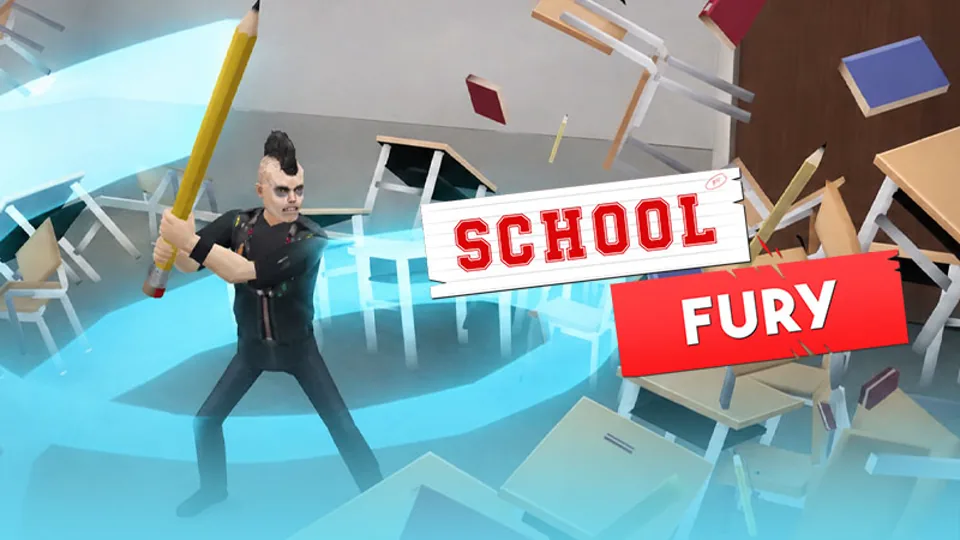
School Fury is a fast 3D arcade destruction game where you smash school props, fight enemies, chain combos, collect coins, unlock upgrades, and chase higher scores.
Classroom Chaos Route
School Fury is a short-session 3D arcade destruction game built around movement, impact, combo pressure, coins, and repeat upgrades. The setting is a fictional school, but the structure is a score chase: move through classrooms, hallways, labs, cafeterias, and school facilities, smash dense groups of props, fight enemies before they surround you, collect coins from the chaos, and return stronger on the next run. Its best moments come from chain reactions, exaggerated knockback, and the feeling that a cleaner route can turn the same room into a much better score.
School Fury's design language is immediate and physical. The 3D rooms give attacks real direction, distance, and collision space. The action pressure comes from enemies and object density rather than complex combo inputs. The destructive interaction is not construction in the Minecraft sense; it is about turning school furniture, obstacles, and room layouts into a route for fast arcade damage.
The fantasy is deliberately exaggerated. Desks, lockers, computers, chairs, cafeteria objects, classroom furniture, hallway clutter, and facility props become targets for quick attacks. Enemies enter the mess, ragdoll effects make hits feel loud, and the run becomes a race between route efficiency and crowd control. A careless player runs in circles hitting isolated objects. A better player learns which rooms contain the most value, clears clustered objects in a line, and uses attacks to open the next path instead of stopping in place.
That route mentality is what gives School Fury more depth than its premise suggests. A weak first attempt teaches object positions. A better attempt keeps the chain moving through dense furniture groups. A stronger build clears obstacles faster and can afford more aggressive paths. After a few runs, the school stops being a backdrop and becomes a routing problem: where should the destruction start, when should enemies be cleared, and which upgrade removes the current slowdown?
Destruction, Combat, Upgrades
The central loop is direct: enter a room, move toward the densest cluster, attack quickly, collect coins from broken objects, deal with enemies only as much as necessary, then improve damage, destruction speed, character outfits, or access to new areas. The best rhythm is forward pressure. Standing still wastes the one advantage School Fury gives you: the ability to turn movement into damage by cutting through groups of objects.
Controls support that pace. On PC, WASD or Arrow keys navigate the environment, the left mouse button launches attacks and smashes obstacles, Spacebar triggers evasive maneuvers or special abilities when available, and ESC pauses. On touch devices, drag movement guides the character while action buttons handle fighting and interaction. The control map is simple, but clean scoring depends on how well you combine movement and attacks.
Early runs should prioritize dense object clusters. One desk alone is rarely worth a detour if a classroom group is nearby. A line through several chairs, computers, lockers, and desks is stronger because the time spent moving produces more destruction. If the scoring chain rewards quick hits, every second between targets matters. If a room has two clusters, pick the one that keeps your exit path open rather than the one that traps you in a corner.
Enemies create the main decision tension. Ignoring them can turn a crowded room into a trap. Overcommitting to every small threat breaks the destruction chain. The practical answer is to fight while repositioning. Knock enemies through furniture when possible, keep a lane open, and clear only enough pressure to return to the route. In School Fury, combat is usually a route-management tool, not a separate duel.
Upgrades keep the repetition useful. Stronger damage shortens object break time. Faster destruction keeps the combo pace alive. Character outfits and new areas add variety once the basic route is understood. Better weapons or attack improvements let clustered props disappear faster. The best upgrade is not always the flashiest one. It is the one that fixes the bottleneck you just felt: low damage, enemy pressure, slow clearing, weak combo flow, or stale routes.
Scoring Habits That Matter
School Fury rewards players who think in lines, not points. A point is a single object. A line is a path through multiple objects, enemies, and rewards without losing pace. Before attacking, look at the room as a chain: first cluster, turn, second cluster, exit lane, enemy position, next room. That planning takes only a second, but it prevents the common beginner mistake of spinning around the room and letting the score pace die.
Route memory matters more after the first few attempts. Learn which rooms have desks packed tightly together, which hallways contain useful object rows, and which facilities waste time with sparse targets. Start with the high-value rooms when your damage is fresh and your run momentum is high. Leave low-density corners for later unless they contain a reward or help you reposition safely.
Spacebar should be used with intention. If it triggers a dodge, save it for crowded moments or enemy pressure. If it triggers a special ability, use it where multiple targets can benefit from the effect. Pressing it randomly may feel active, but it often wastes the one tool that could save a chain. The same logic applies to attacks. Swinging constantly while pointed away from targets creates noise; steering into dense objects before attacking creates score.
Upgrade choices should follow evidence from the last run. If object clearing feels slow, buy damage or weapon strength. If enemies constantly interrupt the route, improve combat reliability. If you already clear rooms quickly but feel bored, try unlocks that change the visual or area variety. This keeps each short session purposeful. One run can test a new route. Another can confirm whether a damage upgrade changed the time needed to clear classrooms. Another can focus on surviving crowded enemy waves.
Clean Short Run Plan
School Fury runs on fast arcade feedback: enter, smash, fight, upgrade, repeat. Destruction toys, ragdoll chaos, score chasing, and short improvement loops all feed the same rhythm. The school setting is not the point by itself. The point is the contrast between an ordinary environment and exaggerated action, with furniture and enemies turning into fuel for a noisy score run.
Deep fighting-game inputs, careful stealth, long narrative progression, realistic school simulation, and puzzle-heavy room solving are not the structure. The design is intentionally blunt. It asks whether movement stays active, clusters are chosen well, enemies are kept out of the route, combo time is protected, and upgrades are spent efficiently. That simplicity is a strength because the goal is a quick action loop instead of a long campaign.
The first session should have a concrete target. Learn the controls, clear one route through the densest classrooms, avoid getting pinned by enemies, and use your first upgrades to improve the weakest part of the run. Do not try to master every room at once. A clean path through two or three high-density areas will teach more than a messy tour through the whole school.
On PC, keyboard movement plus left-click attacks gives the clearest control over route shape. On touch devices, steady drag movement is more important than frantic tapping; attacks work best when the character is close enough to connect with objects and enemies. In both cases, the same rule holds: stay mobile, attack through clusters, protect an exit lane, and spend upgrades on the problem that actually slowed you down.
School Fury is strongest as a compact arcade destruction challenge. It has enough object variety, combat pressure, coin feedback, combo tension, and upgrade rhythm to make repeat attempts meaningful, but it does not bury the run under systems. Learn the room density, keep the chain alive, upgrade with purpose, and the fictional school becomes a route puzzle made out of desks, lockers, enemies, and exaggerated physics.