
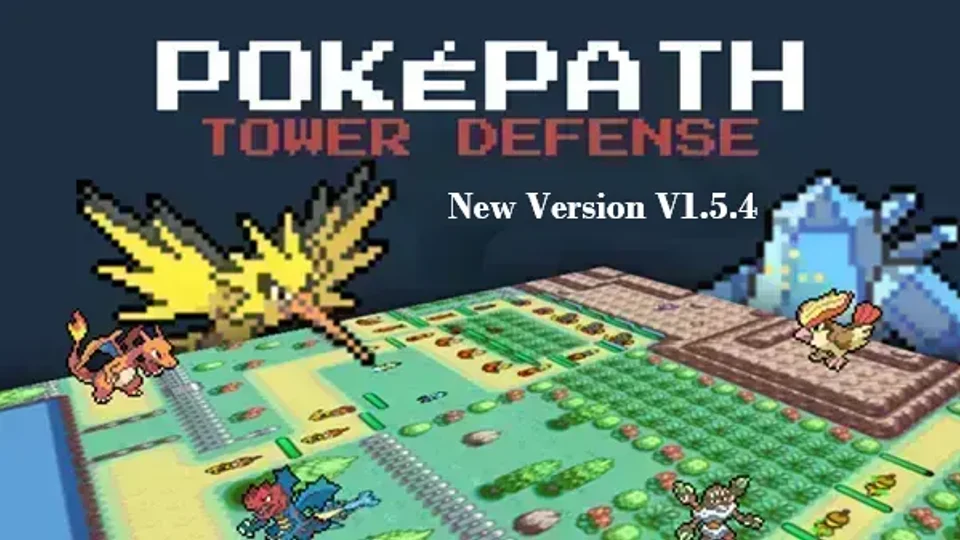











PokePath TD Online Pokemon Tower Defense
PokePath TD is a fan-made Pokemon tower defense game where you place Pokemon-style towers, upgrade them across repeated runs, and adapt to route layouts, bosses, and enemy traits such as shields, regeneration, and invisibility.
Pokemon Tower Defense Through Route Control
PokePath TD is a fan-made Pokemon tower defense game by Khydra built around route defense, Pokemon-style towers, upgrade timing, boss waves, enemy traits, and long-term progression. Instead of moving one trainer across a map, the game turns each route into a defensive puzzle. Place units where their coverage matters, earn resources from waves, upgrade or evolve the right pieces, and keep the path from breaking under pressure.
The tower defense structure gives Pokemon-style roster decisions a different meaning. A Pokemon is not only a creature with a type. It is a tower with range, timing, damage profile, upgrade potential, and placement value. A strong unit in the wrong position can waste most of its power. A modest unit placed on a perfect bend can carry more of the route than expected.
PokePath TD uses nine routes, and that number matters because route shape is the soul of tower defense. A strategy that dominates one route may fail on another if the path length, choke points, boss timing, or enemy movement changes. The game is not only about building the strongest possible tower. It is about reading the map in front of you.
The cleanest loop is simple: inspect the route, place early coverage, survive the first waves, upgrade the tower that touches the most important path segment, adjust for enemy traits, and prepare for bosses before they enter the dangerous part of the route.
Waves, Choke Points, and Upgrade Timing
Each route should be read as a collection of pressure points. A long straight path may reward range. A tight bend may reward splash or repeated hits. A split path may require balanced coverage instead of one overbuilt tower. A boss lane may need concentrated damage where several towers can fire at once.
Early placement should avoid panic. It is tempting to cover the entrance because enemies appear there first, but towers placed near bends or shared path segments often gain more firing time. The best placement is usually where a tower can hit the same enemy for the longest window or cover multiple moments of the route.
Resources create the upgrade decision. Spending too early on the wrong tower can leave the defense thin. Waiting too long can let the wave reach the end. Good PokePath TD play is not only knowing what to upgrade; it is knowing when an upgrade changes the next wave. A tower that barely helps now may become essential after evolution. A cheap supporting tower may be better than one expensive upgrade if the route has multiple lanes of pressure.
Bosses make timing sharper. A boss is not just a larger enemy; it tests whether the build has enough concentrated damage and enough route coverage to keep firing while the boss moves. If bosses repeatedly survive with low health, the route likely needs damage earlier in the path. If ordinary waves leak before the boss arrives, the build may be too focused on one late-game tower.
Shields, Regeneration, and Invisible Pressure
Enemy traits stop PokePath TD from becoming a single static placement puzzle. Shields can reduce or absorb damage, making raw low-impact attacks weaker. Regeneration punishes slow damage that cannot finish enemies before they recover. Invisibility asks for detection, reveal timing, or tower choices that can handle hidden threats.
Those traits change upgrade priorities. A build that clears ordinary waves may fail when shielded enemies arrive. A route that looks stable may collapse when regenerating enemies survive through weak zones. Invisible enemies can punish defenses that only focus on visible front-line pressure.
The answer is adaptation. Add towers that answer the current trait, upgrade the piece that solves the next wave, and avoid relying on one generic damage plan. Pokemon flavor helps here because different towers can feel like different roles: damage dealers, control pieces, coverage anchors, trait counters, and boss killers.
Useful defense habits:
Key Highlights
- Place towers where they get repeated firing time, not only where enemies first appear.
- Upgrade towers that control the route's most important pressure point.
- Prepare for shields, regeneration, and invisibility before they become leaks.
- Use evolutions to turn a good placement into a route anchor.
- Treat bosses as damage checks and ordinary waves as coverage checks.
- Change the build when the route changes; nine routes means no single plan stays perfect.
Long-Term Progression And Auto Mode
PokePath TD has a longer progression layer, so failed runs still matter. A bad clear attempt can reveal which route shape, enemy trait, or upgrade timing caused the failure. Future runs can carry stronger decisions because the player understands where the defense actually broke.
Auto Mode supports repeated experimentation and farming. That does not remove the strategy. It changes the rhythm. Once a route is stable, automated repetition can help gather progress, test whether a build remains reliable, or push resources toward long-term upgrades. But Auto Mode cannot rescue a bad layout forever. A weak route still needs better placement and stronger counters.
Evolutions and upgrades give the game a Pokemon identity beyond its theme. A tower that starts simple can become a central defender after investment. That creates a satisfying arc: place a unit, watch it prove its value, upgrade it into a stronger role, and design the rest of the route around what it now does well.
Clean Route Plan
Start every new route by watching the path before overcommitting. Identify bends, long coverage windows, split pressure, and likely boss zones. Place early towers where they can fire for the longest time, then use the first waves to confirm whether enemies are leaking because of low damage, bad placement, or missing trait counters.
Upgrade with evidence. If enemies reach the end with high health, the route needs stronger core damage. If they barely leak after leaving a specific bend, the tower covering that bend may deserve investment. If shielded or regenerating enemies survive too long, change the tower mix instead of simply adding more of the same.
PokePath TD works because it combines Pokemon-style growth with real tower defense map reading. Nine routes, wave pressure, boss checks, enemy traits, evolutions, upgrades, Auto Mode, and long-term progression all point to one central skill: build the route, then keep rebuilding it when the path proves your first idea was incomplete.