

Minecraft Online
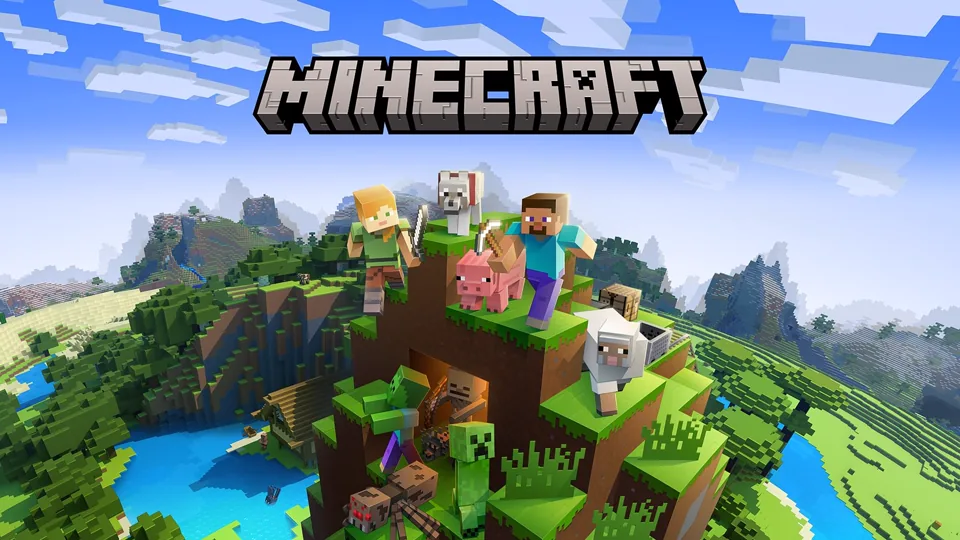
Minecraft is the block sandbox about gathering resources, crafting tools, surviving the night, exploring biomes, building bases, testing redstone, and shaping a world around your own goals.
Blocks as a Planning Language
Minecraft is an open-world sandbox where blocks are landscape, resource, tool, obstacle, and design material at the same time. Dirt can become a wall, wood can become tools, stone can become a furnace, coal can become light, iron can become armor, redstone can become logic, and a hillside can become a mine, tower, farm, village, railway, or base. Every small action can feed a larger plan.
The first loop is simple enough to learn in minutes: break useful blocks, collect resources, craft tools, place blocks back into the world, and use better tools to reach stronger materials. Wood leads to planks, sticks, crafting tables, doors, fences, and chests. Stone leads to stronger tools and furnaces. Coal creates torches. Food supports travel. Iron makes dangerous mistakes less fatal.
Creative and Survival are different ways to play the same block system. Creative removes survival pressure by giving access to all blocks, flight, and freedom from normal harm. Survival keeps pressure in place: hostile mobs, health, hunger, darkness, limited resources, fall damage, and the need to gather what you build with. The distinction matters because Minecraft is not one fixed experience. It is a toolset that changes shape based on the mode and goal.
That flexibility is the game's real identity. One player may treat the first night as the main challenge. Another may build a detailed town, explore caves and dimensions, or create redstone machines, farms, item sorters, doors, traps, and logic systems. Minecraft gives repeatable systems and lets the player decide what progress means.
Survival Turns Blocks Into Risk
Survival mode gives every early decision weight. The sun moves, darkness matters, and the first night arrives before most players feel ready. Wood is the priority because it unlocks the crafting table and basic tools. Stone follows because wooden tools are temporary. Coal or charcoal matters because torches create safety. Food matters because hunger limits travel and recovery. Shelter matters because hostile mobs punish players who ignore night.
A strong first day has a practical sequence: gather logs, craft planks and sticks, make a crafting table, create a wooden pickaxe, mine stone, upgrade to stone tools, collect food, find coal or make charcoal, place torches, and build a small safe shelter. The shelter does not need to be beautiful. A dirt box with light and a door is better than an unfinished dream house when night falls. Beauty can come after survival stabilizes.
A bed changes the first-night problem because sleep lets the player skip danger and reset spawn near home. That makes sheep, wool, and a safe sleeping spot more valuable than they first appear. If a bed is not available, torches and walls matter more. The basic question is always the same: can you survive long enough to keep your inventory and return to work tomorrow?
Mining should be cautious. The famous advice not to dig straight down exists because ordinary ground can hide caves, lava, drops, or empty spaces. Stair-step mines, two-block shafts, ladders, water buckets, and marked tunnels are safer. Torches should be placed consistently, often on one side of the tunnel, so the route home remains readable. Carry spare blocks to bridge gaps, seal openings, or climb out of trouble.
Exploration expands the risk map. Forests provide wood and food sources. Plains make animals and villages easier to spot. Deserts expose temples but offer fewer trees. Mountains create dramatic bases and dangerous cliffs. Caves promise ore and hostile pressure. Oceans need boats. The Nether demands stronger preparation because distance, lava, and enemy types change the rules. The End turns long-term preparation into the Ender Dragon route.
Survival is strongest when the player sets one concrete milestone at a time. Survive the night. Build a starter base. Create a wheat farm. Mine iron. Craft armor. Find a village. Map nearby biomes. Prepare for the Nether. Build a safer mine. Each goal creates a reason for the next block placed. Without goals, the world can feel too open. With goals, every small improvement becomes part of a personal story.
The first base should solve function before style. Put storage near crafting, keep a furnace close to fuel, light every dark corner, mark the mine entrance, leave room for a farm, and build a path to nearby water, animals, or a village. Plain but organized beats beautiful and awkward.
Creative Turns Blocks Into Design
Creative mode changes Minecraft from survival logistics into instant construction. In Creative, building has no normal resource limit, flight makes large projects easier, and hostile pressure no longer interrupts design. The challenge moves from "Can I survive long enough to build this?" to "Can I design something worth building?"
Creative works as a prototype mode. Test a roof shape before gathering materials in Survival. Try a bridge span before committing to stone and wood. Lay out a village road network. Build a tower silhouette and check whether it reads from the ground. Experiment with redstone doors, farms, lighting, or rail systems. Because blocks are instantly available, bad ideas are cheap.
The danger in Creative is choice overload. Access to every block can make a build less focused, not more. Good builders often limit the palette on purpose: two wall materials, one trim material, one roof material, and a few accent blocks. Shape matters before decoration. A house with strong proportions looks better than a pile of expensive blocks. A castle with readable towers, walls, gates, and courtyards works better than a huge rectangle covered in details.
Creative also teaches terrain thinking. Flying above a build reveals whether paths connect, whether roofs line up, whether farms fit the land, and whether a base has a clear landmark. A Survival player can use Creative to learn these lessons quickly, then return to Survival with a build plan that uses realistic materials and scale. The two modes do not have to compete. They can support each other.
Creative is also useful for redstone rehearsal. A piston door, hidden stair, automatic farm, rail switch, or item sorter can be built badly ten times without risking rare materials. Once the mechanism works, the Survival version becomes a resource project rather than a guessing game. That is one of Minecraft's best cross-mode habits: use Creative to learn the shape, then use Survival to make the shape meaningful.
Java, Bedrock, Redstone, Multiplayer
Minecraft exists across major editions, and version context matters. Java Edition is strongly associated with PC communities, custom servers, mods, technical play, snapshots, datapacks, and community experimentation. Bedrock Edition is known for broad cross-platform play across console, mobile, and Windows ecosystems, controller and touch support, Marketplace content, featured servers, and platform-friendly multiplayer. The core loop remains recognizable, but surrounding systems differ.
That edition choice affects expectations. A player who wants independent mods, technical servers, datapacks, and PC-focused experimentation usually looks toward Java. A player who wants console or mobile play, controller support, shared worlds across device families, add-ons, skins, texture packs, and Marketplace-style content usually finds Bedrock easier to coordinate with friends. Neither choice changes the first tree, first pickaxe, or first shelter. It changes the ecosystem around the world.
Redstone is the system that turns blocks into logic. At its simplest, redstone powers lamps, doors, pistons, rails, and switches. At higher levels, it supports clocks, farms, item sorters, elevators, traps, hidden rooms, calculators, and large automation systems. Redstone is optional, but it gives technical players a reason to keep improving long after a base has food, storage, and armor. A good redstone project solves a real base problem first: lighting, access, farming, transport, storage, or defense.
Multiplayer changes the emotional shape of the world. A solo base reflects one player's priorities. A shared world becomes a town because labor and taste split naturally. One player mines, another farms, another builds roads, another explores, another experiments with redstone. Public servers can turn Minecraft into minigames, economies, factions, PvP, roleplay, or large community builds. Private worlds keep the focus on a smaller group and a persistent shared place.
Realms and private servers matter because Minecraft worlds become more valuable when people can return to the same place. Multiplayer planning should start with rules: where the town center is, which chests are shared, how far players can build, whether PvP is allowed, and how major resources are divided. A few agreements prevent scattered bases and missing tools.
Add-ons, mods, datapacks, texture packs, skins, and Marketplace content all extend Minecraft in different ways. Some change appearance, some add mobs or recipes, some alter mechanics, and some provide maps or minigames. New players should learn the base loop before stacking too many changes on top.
Minecraft is strongest when progress begins modestly and becomes personal. Collect wood, make tools, secure food, light a shelter, and choose one next milestone. A safe mine becomes storage, storage becomes a base, a base becomes a farm, and a farm becomes a world with history.