
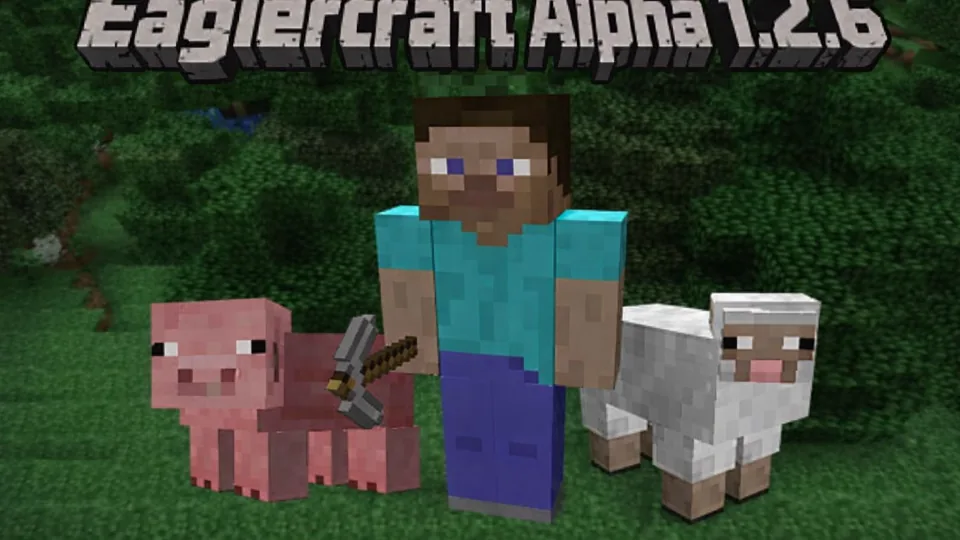





Eaglercraft Alpha 1.2.6 Online
Eaglercraft Alpha 1.2.6 recreates the last Minecraft Alpha-era rhythm: simple survival, rough world generation, night mobs, light management, and basic shelter building.
Final Alpha Survival
Eaglercraft Alpha 1.2.6 is an older Minecraft Alpha-style survival loop with a very specific early-era feel. The version number matters: Java Edition Alpha v1.2.6 was released on December 3, 2010 with server 0.2.8, and Minecraft Wiki identifies it as the last version of the Alpha development phase before Beta 1.0. The rhythm is trees, caves, simple crafting, night danger, rough world generation, and fewer modern systems competing for attention.
The key difference is what the game does not ask from you. Alpha-style play is less about layered progression and more about immediate survival. There is no modern hunger loop shaping every trip, no enchantment table route, no sprint-era combat expectation, and no long checklist of biomes, bosses, and update-specific mechanics. Health, tool durability, light, terrain awareness, and shelter matter more than complex systems. That gives Alpha 1.2.6 its early block-world rhythm: fewer rules, sharper consequences, and a first night that still feels like an event.
This also changes how you value ordinary items. Food is not a renewable hunger-management layer in the modern sense; it is emergency health recovery, and older food handling makes inventory space feel tighter. Beds are not the answer to night in this era, so shelter is not optional decoration. If you die far from spawn, the walk back can become the real punishment. That makes a small base near recognizable terrain more valuable than a dramatic build placed before you understand the surrounding caves.
Eaglercraft gives Alpha 1.2.6 a lightweight old-version route. The important promise is not modern feature depth; it is the final Alpha rhythm: rough terrain, torch-lit caves, simple tools, fragile safety, and a world that feels dangerous before any complicated progression system appears.
First Night, Torches, and Terrain Hazards
The basic controls are direct: move with WASD, jump with Space, open inventory with E, break blocks with left click, and place blocks with right click. From there the first loop is familiar but stricter than it looks: gather wood, make tools, collect stone and coal, place lights, and build shelter before night brings enemies. Because Alpha survival has fewer later safety nets, the opening minutes carry real weight. A small, finished hut with light is better than a large, unfinished base that exposes you after sunset.
Minecraft Wiki's Alpha v1.2.6 article clarifies what this version represents historically. It was primarily a bug-fix release, but it also added small water lakes and rare lava pools to world generation, both on the surface and in caves. That means exploration can produce simple but meaningful hazards. A surface lava pool may be useful later, but early on it is a risk around forests, animals, and careless movement. A small lake can shape where you build, where mobs move, and how you mark a route back home.
The cave loop is also cleaner than in later Minecraft. You are not juggling a large modern item ecosystem. You need visibility, exits, tools, and caution. Torches are not decoration; they are how you turn unknown space into usable space. Coal is not just fuel; it is safety. Stone tools are not glamorous, but they are the difference between slow improvisation and controlled progress.
That older cave pressure is a major part of the identity. A good cave can sprawl, double back, drop suddenly, and hide enemies behind repeated stone, gravel, and darkness. Because there is no sprint escape rhythm, a bad route is harder to correct after a creeper or skeleton appears. Mark exits early. Place torches consistently on one side of the tunnel so the way home stays readable. Carry extra wood or a crafting table for long underground trips, because one broken pickaxe in a deep branch can turn a good mining trip into a slow retreat.
Coal deserves special attention. Modern players often treat coal as background material, but Alpha survival makes it central again. Torches decide whether a mine becomes a base extension or a blind risk. Furnaces turn ore and pork into usable recovery and gear. If you cannot find coal early, adjust the plan: gather more wood, stay near the surface, and avoid committing to a long cave push before light is solved.
Building follows the same philosophy. Start with function: walls, a roof, a door, light, and a way to see outside without exposing yourself. Once the first night is handled, expand into storage, a mine entrance, a farm-like resource area if supported by the loaded build, and a safer path to nearby caves or water. The fun is not in reaching endgame systems. The fun is in making a rough world gradually feel survivable.
Key Highlights
- Gather wood early so a crafting table and tool set are ready before dark.
- Mine coal or prepare another light source before pushing into caves.
- Build small first; a tight shelter is more useful than an unfinished large base.
- Watch health and enemy distance, because this older rhythm is less forgiving when you are unprepared.
- Use simple weapons and torches before exploring deeper cave systems.
- Respect lava pools and cave drops because old-version terrain can punish careless movement quickly.
- Keep landmarks simple; early worlds can look repetitive before modern biome variety and navigation aids.
Golden-Age Minecraft Rhythm
Eaglercraft Alpha 1.2.6 captures the golden-age side of Minecraft survival, where a simpler sandbox makes the first night matter again. It is also a useful comparison point inside the Eaglercraft family because Alpha 1.2.6 has a very different promise from later clients.
Later server-oriented combat belongs more naturally to Eaglercraft 1.8.8. A broader newer classic branch points toward Eaglecraft 1.12.2 U2. Eaglercraft Alpha 1.2.6 is the stripped-back path: basic blocks, early crafting, torch-lit caves, simple weapons, and survival decisions that are easy to read. Modern mobs, modern UI polish, complex villager systems, Redstone depth, advanced commands, and update-era progression sit outside the center of this branch.
Nostalgia also matters. Alpha 1.2.6 sits at a turning point: late enough to feel like recognizable survival Minecraft, early enough to lack many systems that later became normal. That makes the game feel quieter and harsher at the same time. There is less to remember, but mistakes are more visible. You either have light or you do not. You either have shelter or you are outside. You either prepared tools or you are punching your way through the night.
Alpha 1.2.6 is not simply "less content"; it is a different balance of friction. The limited interface makes every inventory slot matter. The absence of modern movement makes distance feel larger. The simpler block palette makes navigation more dependent on your own landmarks. Even a plain staircase, a torch pillar, a cobblestone marker, or a doorway facing the right hill can become part of how you read the world.
Simple Goals for the First World
For the best first session, set a deliberately small Alpha goal: build a torch-lit hut, craft stone tools, secure a cave entrance, or survive one night without wandering too far. Do not waste the first day planning a perfect house. Chop wood, craft, mine, and close a safe box around yourself. Once the first night passes, you can improve the base.
Carry torches before entering caves. In Alpha-style play, darkness is information failure. You need to know where the floor drops, where a tunnel turns, and whether a mob can approach. Place lights as breadcrumbs, not just as area coverage. If you get lost, following your own torch pattern should lead you back to a known route.
Be careful around water and lava features. Alpha v1.2.6's world-generation notes specifically include small water lakes and rare lava pools, so expect simple terrain hazards to matter. Water can slow a retreat. Lava can end a careless run or destroy dropped items. Mark useful hazards from a distance, then return when you have blocks, tools, and a plan.
For a clean start, use a three-ring plan. The inner ring is the shelter: chest, furnace, crafting table, door, roof, and enough light to make it readable at night. The middle ring is the work area: trees, a mine entrance, a short path, and a place to fight mobs without exposing the door. The outer ring is exploration: caves, lakes, lava, animals, and hills you can recognize from a distance. Expand only when the closer ring is stable.
Most importantly, play it as Alpha. Do simple things cleanly. Build a small shelter instead of a grand base. Mine a safe staircase instead of diving into the first dark cave. Keep food, tools, and light organized if the loaded build provides them. The value is the old rhythm: fewer systems, clearer stakes, and a direct route back to the moment when surviving the first night was still the main story.