









Pokemon Lithic Veil Online Fangame
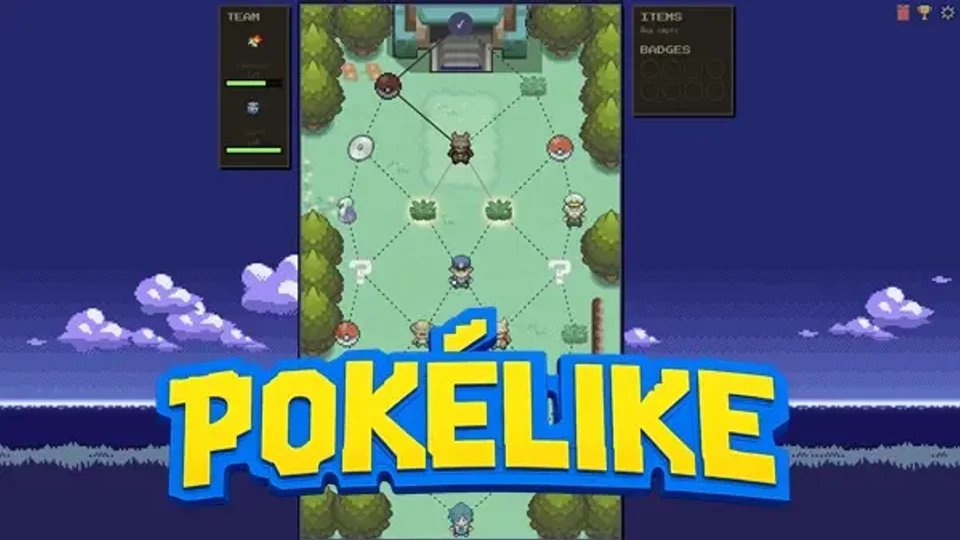
Pokemon Lithic Veil is a point-and-click Pokemon fangame with automatic battles, team management, gym-style progression, and a slower mystery-driven rhythm built around secrets and route discovery.
Point-And-Click Pokemon Adventure
Pokemon Lithic Veil is a point-and-click Pokemon fangame by Khydra with automatic battles, team management, leader progression, region travel, and secret hunting. The control style changes the whole rhythm. Instead of constant movement inputs or turn-by-turn command selection, the game asks the player to navigate, prepare the team, make roster decisions, and let the battle layer resolve.
That makes Lithic Veil slower than an action fangame, but not empty. The pressure moves away from reflexes and into planning. A weak team, poor coverage, or careless progression route still creates problems. Automatic battles do not remove strategy; they move strategy earlier, into what the team looks like before the fight starts.
The point-and-click structure also makes exploration feel deliberate. Locations are not only hallways between battles. They become spaces to inspect for events, leaders, secrets, and routes into the next region. Lithic Veil works best when the player treats the map like a mystery board: click through areas, check details, improve the team, then return to challenges that were too hard earlier.
Johto and Kanto-style nostalgia appears in public descriptions around the game, and that matters because the structure leans on familiar Pokemon adventure language: regions, leaders, teams, hidden discoveries, and gradual progress. Lithic Veil is not trying to be a pure competitive battler. It is an exploration-first fan adventure where automatic combat keeps the pace relaxed while the world keeps giving reasons to move forward.
Automatic Battles Still Need Planning
Automatic battles change where decisions happen. In a traditional battle, a player can correct a bad opening by manually choosing a safer move. In Lithic Veil, the team must be prepared before the fight. That gives roster building more weight. Type coverage, evolution timing, level strength, move access, and team order all matter because the battle will test those choices without constant rescue from manual commands.
Leader fights sharpen this system. A leader is not just another wild encounter; it is a checkpoint that asks whether the current team has actually grown. If a leader battle fails repeatedly, the answer is usually not faster clicking. The answer is a better team: stronger levels, cleaner coverage, a different roster member, or progress through an area that provides the missing option.
Automatic combat also makes weak links visible. A Pokemon that looks useful in the collection may fail when it cannot survive long enough, hit the right target, or contribute the needed damage. A more balanced team can outperform a team built only from favorites because the battle system rewards prepared roles.
Useful battle habits:
Key Highlights
- Build around coverage instead of stacking the same type or role.
- Treat leader losses as information about the team's missing answer.
- Revisit earlier areas when progress stalls; the missing piece may be outside the current route.
- Keep a stable core, then rotate one slot at a time to diagnose problems.
- Watch how automatic fights fail instead of only checking whether they fail.
- Let exploration and battle preparation feed each other.
Regions, Leaders, and Secret Routes
Lithic Veil's progression is built around moving through regions, defeating leaders, and uncovering hidden events. That gives the adventure a clearer shape than a loose auto-battle sandbox. A region introduces an area identity. Leaders act as gates. Secrets create optional curiosity between major checkpoints.
The secret layer is important because point-and-click games become stronger when observation matters. A hidden route, event trigger, unusual interaction, or off-path discovery can make the world feel less like a simple menu. The slower control style gives the player time to notice details that would be missed in a faster game.
Region progression also keeps team growth grounded. A new region should not be treated as a new background. It may bring different encounters, stronger opponents, better team options, and fresh problems for the automatic battle system. If the team has been coasting, a new region can expose that weakness quickly.
Leaders create a clean rhythm: explore, gather strength, challenge, diagnose, adjust, and move on. The loop is familiar, but Lithic Veil's hands-off combat changes the feeling. Winning a leader fight means the preparation held up. Losing means the plan needs work.
Building A Team For A Slower Adventure
Start by making the team reliable rather than flashy. A single strong Pokemon can carry early progress, but automatic battles become more stable when several team members can contribute. Coverage matters because the player cannot manually micromanage every turn. Durability matters because a fragile plan may collapse before the strongest move can matter.
Then pay attention to route feedback. If ordinary encounters are taking too long, the team may need stronger damage or better typing. If leader fights are ending suddenly, the team may need defensive coverage or a different lead. If progress feels unclear, search the current and previous areas for secrets, missed events, or alternate routes.
Because the game uses point-and-click navigation, patience is part of the design. Inspect areas. Click deliberately. Return after upgrades. Hidden content rewards players who treat exploration as active play rather than empty walking.
Pokemon Lithic Veil works because it turns Pokemon fan-game structure into a calmer exploration system: click through regions, manage the team, trust automatic battles to test preparation, defeat leaders, and follow secrets into the next part of the world. The result is slower than a battle-heavy route, but its strategy still has teeth.