
Sandbox Playground: Plants Vs Zombies Online
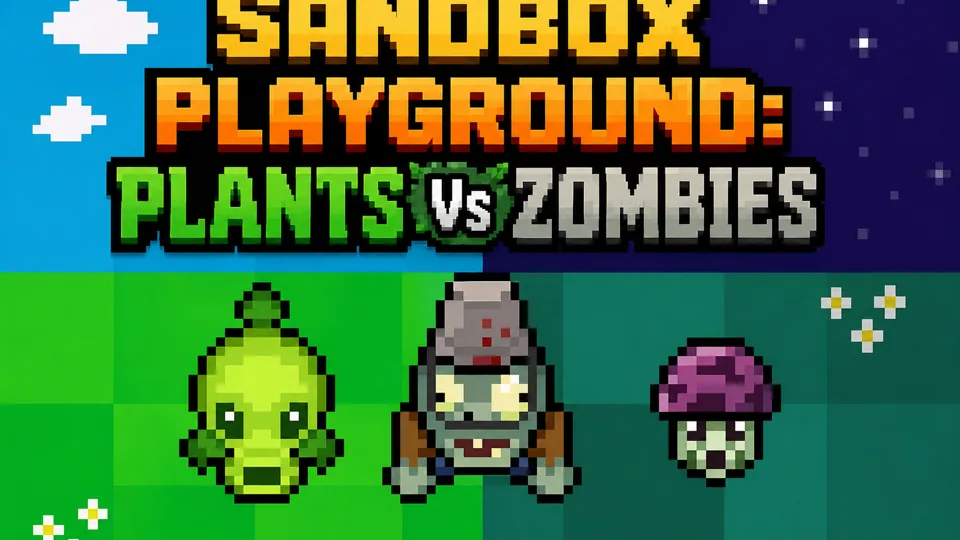
Sandbox Playground: Plants Vs Zombies is an ArtodiGames sandbox where you place plants, zombies, upgrades, and scenario objects, then watch custom battles unfold.
ArtodiGames Plant-Zombie Toybox
Sandbox Playground: Plants Vs Zombies is an ArtodiGames sandbox battle simulator built around custom plant-and-zombie encounters. Its identity is not a strict lane-defense campaign, but a loose scenario tool where the fight is built by hand. The important ingredients are simple and direct: place units, pause the action, adjust the camera, delete objects that do not serve the test, and rebuild the field until the matchup behaves correctly.
The familiar plant-versus-zombie idea is present, but the structure is different from a traditional tower-defense level. There is no fixed puzzle solution, no scripted lane economy, and no single correct build order. Plants and zombies are the pieces. The player decides where they appear, how many enter the field, when action pauses, how close the camera sits, and when a mistake should be removed.
Playhop lists it under casual and simulators, which fits the feel better than calling it a strategy campaign. The player is not climbing a mission ladder. The player is building a test bench. One setup might ask whether a basic shooter plant can hold against a slow zombie. Another might ask what happens when a tougher cone- or bucket-style enemy walks into a powered-up plant line. The value is in the question you create.
That makes the game closer to a light battle lab. You can stage a tiny duel, a crowded swarm, an upgraded plant test, a mixed zombie rush, or a deliberately chaotic scene. The fun comes from creating a question, watching the answer unfold, and rebuilding the setup until the result becomes interesting.
Object Panel, Pause, Camera, Trash
The most important controls are editing tools rather than combat inputs. Five practical pieces define the experience: the left panel adds objects to the field, the upper-right button pauses the action, the right-side slider adjusts camera size, the finger button moves the camera, and the trash button deletes placed objects.
The left panel is the creative source. It turns the game from a passive fight into a buildable test. Place plants, place zombies, add scenario elements, and see how the arrangement behaves. Because the panel is always central to the loop, the best first session is not about creating the biggest scene possible. It is about learning what each object does.
That object-first design makes naming and grouping important. Put similar plants together when testing raw damage. Split them apart when testing coverage. Put zombies in a single file to observe one defender. Spread zombies across the field to test whether an upgraded plant can handle pressure from more than one angle. The same units can produce very different results when their spacing changes.
Pause is the control that makes experimentation readable. Without pause, a sandbox battle can become noise. With pause, you can stop the action, inspect the field, delete a problem, change spacing, add a counter, and resume. That single tool changes the game from random chaos into controlled testing.
The camera tools matter because the battlefield can outgrow one view. A close camera helps inspect one plant's attack, one zombie's movement, or one small matchup. A wider camera helps judge the whole formation. The movement button lets you follow the active part of the fight instead of losing track of the important clash.
The trash button is not just cleanup. It is iteration. Bad object placement, overcrowded scenes, and failed experiments should be removed quickly. The best sandbox play uses deletion as often as addition.
It also protects performance and readability. A plant-zombie playground can become slow or visually useless if too many units are fighting at once. When the result becomes a blur, remove half the objects before adding more. A smaller scene that answers one question is stronger than a massive scene where no interaction can be understood.
Scenario Design Instead of Lane Solving
Sandbox Playground: Plants Vs Zombies should be played as scenario design. A good setup begins with a clear question. Can one upgraded plant hold against a crowd of basic zombies? Does spacing change the result? Does a mixed zombie group break through faster than one strong zombie? Is a special ability better near the front or behind other defenders? Does a wide layout create a different outcome than a compressed one?
Start small. Place one plant type and one zombie type with enough distance to observe their behavior. Run the fight. Pause. Change one variable. Run it again. This method teaches faster than filling the field immediately because the result stays legible. If everything changes at once, you learn almost nothing.
Once basic interactions are clear, scale the scene. Add a second plant group, then a second zombie type. Try an upgraded plant. Move the front line. Create a weak side and a strong side. Use the camera slider to compare local duels with the full field. The sandbox becomes more satisfying when the chaos has structure underneath it.
Balance testing is the best way to make the sandbox feel meaningful. A fair test changes one factor at a time: plant count, zombie count, distance, upgrade level, formation width, or starting position. If plants win too easily, add zombie pressure or shorten the distance. If zombies overwhelm instantly, add spacing, upgrade a defender, or split the wave so the first contact is readable. The goal is not always perfect balance. Sometimes the best scene is deliberately unfair. But even an unfair scene becomes better when you understand which choice made it collapse.
Why the PVZ Theme Works Here
The plant-zombie theme works well in sandbox form because the sides are visually readable. Plants imply defense, spacing, and special abilities. Zombies imply pressure, crowding, and movement. Even without a strict campaign mission, the player understands the basic conflict quickly. That frees the game to focus on composition: what happens if these units meet under this arrangement?
The funny and pixel-style presentation also supports experimentation. The game is not asking for a serious military simulation. It is asking the player to create strange battles, watch them break, and adjust the field. A silly mismatch can be just as valuable as a balanced fight if it teaches how a unit behaves.
This is also why direct editing is important. In a normal strategy level, failure often means restart. Here, failure can become part of the scene. Pause, delete, move the camera, add a counter, and continue. The game rewards curiosity more than perfect planning.
Strong First Experiments
A clean first experiment is one plant group against one zombie group. Keep the distance moderate so you can see whether the plant damage, firing pattern, or special behavior matters before contact. If the zombies always overwhelm the plants, reduce the count or add spacing. If the plants always dominate, add a stronger zombie or shorten the distance.
A second experiment should test upgrades. Use the same enemy group, then compare the base plant against an upgraded version. Do not change everything else at the same time. The point is to learn whether the upgrade improves damage, control, survivability, or timing.
If upgrades include special effects, test them as roles rather than raw power. A slowing effect pairs well with high damage because it keeps zombies inside the attack window longer. A defensive or durable plant can create a front line for fragile damage dealers. A splash or area effect matters more against groups than against one sturdy target. The sandbox becomes clearer when every upgrade has a job.
A third experiment should test layout. Put defenders in a compact group, then spread them out. Put zombies on one side, then split them. Use close zoom to observe the first clash and wide zoom to judge the whole field. Sandbox games become deeper when layout becomes a variable rather than a background.
When the scene grows too busy, pause and clean it. Delete clutter, move the camera, and return to the question you were testing. If you are no longer sure what the battle is supposed to prove, the setup is too messy.
Sandbox Playground: Plants Vs Zombies turns the plant-versus-zombie idea into a creative experiment rather than a fixed puzzle route. Each run works like a small lab test: place, observe, pause, adjust, delete, and rebuild until the fight tells you something new.
The best custom battles usually have a sentence behind them. "A small plant squad defends a narrow choke." "A weak front line buys time for upgraded damage plants." "A zombie swarm overwhelms a pretty but badly spaced garden." Those sentences keep the toybox from becoming random. Build the sentence, run the scene, then change one word of the sentence and test again.