




People Playground Online
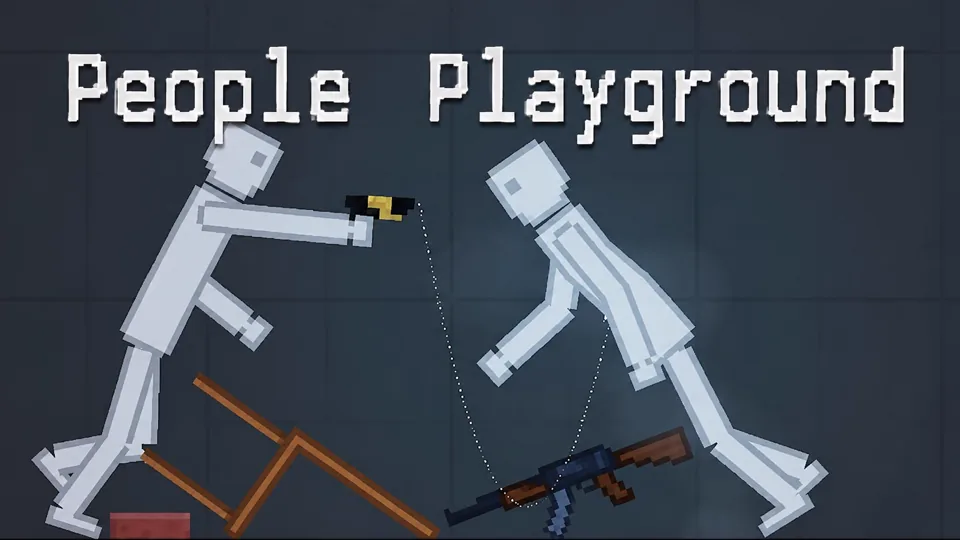
People Playground is a physics sandbox where ragdolls, props, vehicles, weapons, fire, electricity, gravity, and collisions become your experiment kit.
System-Driven Ragdoll Laboratory
People Playground is a physics sandbox built around one simple idea: give the player a room full of objects, then let the simulation answer every question. The Steam release by mestiez and Studio Minus launched on July 23, 2019, and its premise is blunt: a large open space, ragdolls, tools, physical materials, and the freedom to test violent cartoon reactions. For our game library, the useful way to describe it is not as a mission game, but as a system-driven lab where objects, weight, heat, electricity, impact, and timing create the result.
The compact version keeps the important People Playground loop intact: select an item, place it, move it, activate it, pause or reset when the experiment gets messy, then try a cleaner version. That rhythm is why the game is often grouped with ragdoll, physics, sandbox, simulation, construction, destruction, and casual experiment games rather than with ordinary action levels.
What makes People Playground different from a normal destruction toy is the object interaction layer. A single prop can be funny for a few seconds, but the real value appears when you combine systems. The broader People Playground toolbox is commonly organized around entities, melee tools, firearms, explosives, vehicles, machinery, biohazard items, and miscellaneous props. Those labels matter because each category answers a different kind of question: bodies show force and damage, melee tools show contact and sharpness, firearms show penetration and timing, explosives show blast shape, vehicles show momentum, and machines turn one input into a repeatable output. Objects can also carry properties such as weight, sharpness, thermal and electrical conductivity, ferromagnetism, heat capacity, and bullet resistance. Temperature, heat transfer through objects and air, electricity, and rigid-body dynamics are simulated together. That is why fire behaves differently from blunt force, why electricity can change a setup, and why machinery can turn a static scene into a chain reaction. Good play is not about memorizing a route; it is about asking a physical question and building a setup that answers it.
Objects, Properties, and Chain Reactions
The core loop starts with selection. Choose a character, prop, weapon, machine, or environmental item, then place it in the scene with the mouse. Most versions lean on direct manipulation: click to select, drag to move, use menus or secondary actions to adjust behavior, scroll to zoom, and use pause or reset to inspect the scene before the next activation. The exact interface can vary, but the design logic is consistent: the mouse is your hand, the object library is your toolbox, and the physics engine is the result generator.
People Playground has no need to hide its objective because the objective is player-authored. One session might be about building a compact chain reaction with a few props. Another might test how a vehicle hits a barricade. Another might compare what happens when a ragdoll is moved, dropped, pushed, or exposed to a different tool. The game rewards repeated, small adjustments more than huge first attempts.
The wider People Playground identity leans heavily into contraptions. Airplanes, walkers, automatic doors, shields, bases, computers, vehicles, and strange weapon systems all fit the same design language: objects are useful when they interact predictably enough to become a system. Steam Workshop culture around People Playground shows why the game has stayed relevant for so long: builders share machines, maps, vehicles, expanded object packs, and elaborate scripted-looking devices made from ordinary parts. Even when playing a smaller online adaptation, that context matters. The heart of the game is not merely placing ragdolls, but arranging systems that behave consistently enough to study.
Physical properties decide which experiments are readable. A heavy object changes momentum. A sharp object changes contact. A conductive object can carry electricity through a setup. A high heat-capacity object behaves differently under fire than something fragile. Bullet resistance changes how useful a barrier is. Ferromagnetic behavior can matter when magnets or related tools enter the scene. Thinking in properties makes the sandbox less random: the same collision can produce different outcomes because the objects are not interchangeable.
Temperature is one of the clearest examples of People Playground's system-first design. Community updates and showcases have highlighted tools such as a heat ray, freeze ray, heat lamp, heat pipe, and thermostat. Those names are useful because they explain the grammar of the sandbox. The heat ray applies a direct thermal effect. The freeze ray pushes the opposite direction. A heat lamp can hold a target temperature instead of simply adding chaos. A heat pipe suggests transfer from one place to another. A thermostat turns temperature into a condition that can be monitored or controlled. Once you understand that logic, a fire scene becomes more than visual damage: it becomes a controlled test of source, transfer, insulation, material response, and timing.
That is also why machinery should be tested slowly. A vehicle is not just a moving prop; it is a mass, a contact surface, and a timing problem. A shield is not just a wall; it is a question about bullet resistance, angle, and whether the support structure fails first. A weapon system is not just a gun; it is ammunition flow, trigger timing, recoil, aim, and impact behavior. The more you treat every object as part of a system, the less the sandbox feels like random destruction.
The strongest way to play is to treat every scene like a lab table. Start with one ragdoll and one object. Observe the reaction. Add a second object only when you understand the first one. If a setup becomes unreadable, pause or reset instead of stacking more chaos on top. The better you control spacing, angle, timing, and activation order, the more surprising the results become.
Useful habits:
Key Highlights
- Start with a small number of items so you can see which object caused the reaction.
- Use zoom and camera movement to inspect joints, collisions, and timing instead of guessing.
- Test fire, electricity, explosives, and gravity separately before combining them.
- Think about material properties: heavy objects, sharp objects, hot objects, conductive objects, resistant objects, and fragile objects all create different outcomes.
- Reset often; a clean experiment teaches more than a cluttered scene.
- Build one chain reaction at a time, then expand it when the first sequence works.
Physics Sandbox Logic
The right expectation is important. People Playground is not a polished mission game with a tutorial route and a win screen. It is a freeform simulation space built around curiosity, patience, and willingness to test small systems. It also carries mature cartoon violence, so the real focus should be physics experimentation, not shock value alone.
Sandbox systems, physics simulation, ragdoll reactions, contraption building, object libraries, and emergent comedy from colliding systems define the experience. Melon Playground-style experimentation exists nearby, but People Playground's identity is cleaner scene setup and physical response. Clear quests, progression rewards, character leveling, and scripted story are not the engine here.
People Playground belongs near Humans Playground, Melon Sandbox Online, and other physics sandboxes, but its strength is more mechanical than cosmetic. The player is not just watching ragdolls fall. The player is arranging conditions, triggering tools, and reading the consequences.
Clean Experiment Habits
Begin with a small test rather than opening every category at once. Physics sandboxes expose many objects, UI menus, and simulation tools, and the fastest way to learn them is to start with one simple interaction before adding more variables.
Use the mouse deliberately. Selection, dragging, object activation, zoom, and action menus are the real controls. If this version exposes pause or reset, use them constantly. Pause gives you time to adjust placement before the next event; reset lets you compare a new version of the same idea without leftover clutter.
The best beginner experiment is a three-step scene: one ragdoll, one moving object, one environmental effect. Watch what happens, then change only one variable. Move the object closer, adjust the angle, replace the effect, or add a delayed trigger. This keeps the sandbox readable and turns random chaos into repeatable discovery.
Once the basic interaction is clear, build toward a contraption rather than a pile. A door that opens at the right time, a vehicle that reaches a target, a bridge that collapses only after a trigger, or a machine that transfers heat or electricity in sequence teaches more than filling the entire scene with props. People Playground becomes more interesting when every object has a reason to exist.
For a longer session, use a repeatable build order. First choose the experiment category: body reaction, weapon test, vehicle impact, thermal transfer, electrical behavior, explosive chain, or machine automation. Then place only the required parts. After that, run the scene once without decoration. If the test fails, fix spacing, support, timing, or object choice before adding anything else. Decoration, extra weapons, and large explosions are best saved for the final version because they hide the cause of failure. The cleanest People Playground builds look simple at first, but every piece has a job.