


Jacksmith Online
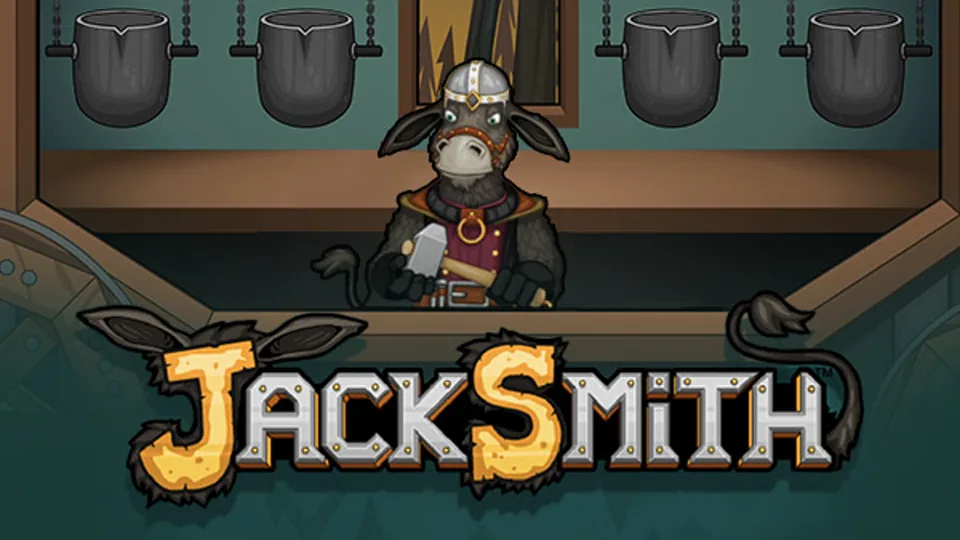
Jacksmith is Flipline Studios' hands-on blacksmith strategy game where you forge weapons, equip warrior clans, gather loot, fire cannons, and advance toward Dudley.
Forge-First Fantasy Strategy
Jacksmith is a Flipline Studios weapon-building strategy game released on September 27, 2012. Its premise is still distinctive: the hero is not the warrior swinging the sword, but the donkey blacksmith making the sword before battle begins. Every day starts at the forge, moves through hands-on weapon production, then continues into a road battle where the quality of your work is tested by monsters, durability loss, elemental matchups, and loot collection.
That structure makes Jacksmith more than a simple upgrade game. You are not pressing one button to buy a stronger sword. You choose the ore, choose the mold, melt the material, pour it into shape, hammer or assemble the body, attach parts, and present the finished weapon to a warrior clan. A clean pour, accurate assembly, and correct part choice affect the final result. A sloppy step is not cosmetic. It follows the weapon into combat.
The adventure has a clear purpose: keep moving across monster-blocked lands toward the Great Wizard Dudley. Warriors fight ahead of the wagon while Jacksmith gathers loot, recovers ores and parts, and supports the battle with cannon shots once those options unlock. The road and the forge feed each other. Better weapons clear harder fights. Harder fights return better materials. Better materials raise the ceiling for the next order.
Flipline's own game feature list gives the campaign real scale: six unique warrior clans, seven lands, more than 135 enemies, more than 275 unique parts, more than 80 Epic Weapons, unlockable cannonballs, elemental enemies, and more than 80 badges. The exact numbers matter because they show why the same daily structure stays fresh. The question is never only "can you craft a weapon?" It becomes "can you craft the right weapon, for the right clan, with the right ore, using the right parts, against the right enemies?"
Hands-On Weapon Work
Jacksmith is controlled with the mouse, but the forge is detailed. Each order begins with a warrior requesting a weapon family. You choose a mold or blueprint, select ore, melt it until ready, pour carefully, then complete the weapon through hammering, assembly, or part placement depending on the type. The game measures accuracy through the small actions: timing the melt, filling the mold cleanly, aligning components, and finishing the design without rushing.
The six warrior clans give the weapon list structure. The Pigarius Legion orders swords such as Longsword, Gladius, and Falchion. The Cluckshire Brood uses bows such as Simple Bow, Winged Bow, and Curled Bow. The Capriloch Clan wants axes such as Double Axe, Broad Axe, and Dragon Axe. The Martello Flock carries shields such as Pointed Shield, Round Shield, and Box Shield. The Meadowguard orders pikes such as Spetum, Trident, and Moonblade. The Oxdin Herd uses maces such as Pegged Mace, Spiked Mace, and Battle Mace.
Those families do not feel identical. Swords emphasize casting and shaping. Bows and arrows lean into assembly and matching pieces. Axes, shields, pikes, and maces each punish different kinds of carelessness. A player who is accurate with swords may still need practice placing shield parts or assembling ranged weapons. That variety is the reason Jacksmith feels like a craft game rather than a menu economy.
Ore quality changes the final ceiling, but better material does not erase bad workmanship. A carefully made weapon from ordinary ore can outperform a sloppy weapon made from rare metal. This is the central lesson of Jacksmith: material and skill multiply each other. Spend valuable ore only when you understand the weapon step well enough to convert it into real strength.
Clans, Epic Weapons, and Elements
Epic Weapons add a blueprint-driven layer. Flipline Wiki material identifies 84 Epic Weapons in total, with 14 designs per weapon type. These are not generic upgrades. They require specific parts and reward players who understand the recipe structure. Epic Weapon designs can be earned by defeating all monsters on a trail during a day, which connects combat performance back to forge planning.
The six clans also change how you read orders. Each clan is tied to a weapon family, so your weak craft type becomes visible over time. If Pigarius swords perform well but Martello shields collapse early, the issue is not the whole strategy. It is a specific production skill. Jacksmith becomes more manageable when you track which weapon families need practice instead of treating every failed battle as a general problem.
Elements become more important as the campaign advances. Jacksmith includes elemental enemies, and a weapon that looks strong in raw numbers can underperform if the match is poor. If a route leans toward a specific threat, craft for that road rather than for the flashiest material. Element planning, part choice, and weapon quality should be read together. A balanced weapon may be safer than a high-power mismatch.
Badges and collection goals provide extra reasons to play carefully. More than 80 badges means the game rewards more than raw completion. You are encouraged to improve forge accuracy, clear trails, collect parts, learn enemy behavior, and experiment with materials. It is a completionist structure built around craftsmanship rather than pure grinding.
Road Battles and Cannon Support
The battle phase is active. After the warriors receive their gear, they move along a monster-filled trail while Jacksmith rides with the wagon. You do not directly replace the fighters, but you still influence the outcome. Monsters drop loot, ores, weapon parts, and other rewards, and collecting them quickly determines what you can build later. Missing drops means weaker supply. Weak supply means weaker orders. The forge depends on what the battlefield returns.
Cannonballs make the battle phase more interactive. Scout and the wagon can provide support through cannon shots and bombs after those options unlock. Fire, ice, repair, and other effects can protect weak moments, speed up dangerous fights, or rescue a route that is starting to fall apart. Cannon support should not be reserved only for panic. Used early, it can preserve durability and create cleaner loot opportunities.
The enemies are designed to report on your forge work. If a weapon breaks quickly, durability, material, or assembly accuracy may be the problem. If damage feels low, the ore, element, weapon family, or part quality may be wrong. If the warriors survive but fights take too long, cannon timing or a missing Epic Weapon bonus may be the issue. Every battle should be read as feedback for the next day.
This feedback loop is why Jacksmith stays engaging. The forge is preparation, battle is testing, loot is supply, and the next forge session is correction. A poor day is not wasted if it teaches exactly where the production chain failed.
Practical Crafting Plan
Begin by mastering accuracy with common materials. Learn melt timing, pouring control, hammer placement, and part alignment before spending rare ore. The goal of early play is not to make the strongest possible weapon immediately. It is to build reliable habits so stronger materials later produce a real jump in quality.
Spend rare parts with purpose. If an order supports an Epic Weapon recipe, save the correct components instead of scattering them across ordinary builds. If the next road contains elemental threats, choose ore and design around those enemies. If a clan keeps underperforming, practice that weapon family with safer materials until the scoring improves.
During battle, collect aggressively but do not ignore cannon timing. Loot builds the future, while cannon shots protect the present. Move quickly for drops, but fire support when enemies threaten to break weapons or overwhelm the front line. A clean battle returns more material and can unlock stronger designs.
Jacksmith is built around precision crafting, fantasy progression, material planning, task-focused Flipline design, and preparation that visibly affects battle results. It is not about direct swordplay, open-world roaming, or sandbox building. Its satisfaction comes from making better equipment one careful step at a time, then watching that craft survive the road ahead.