



Humans Playground Online
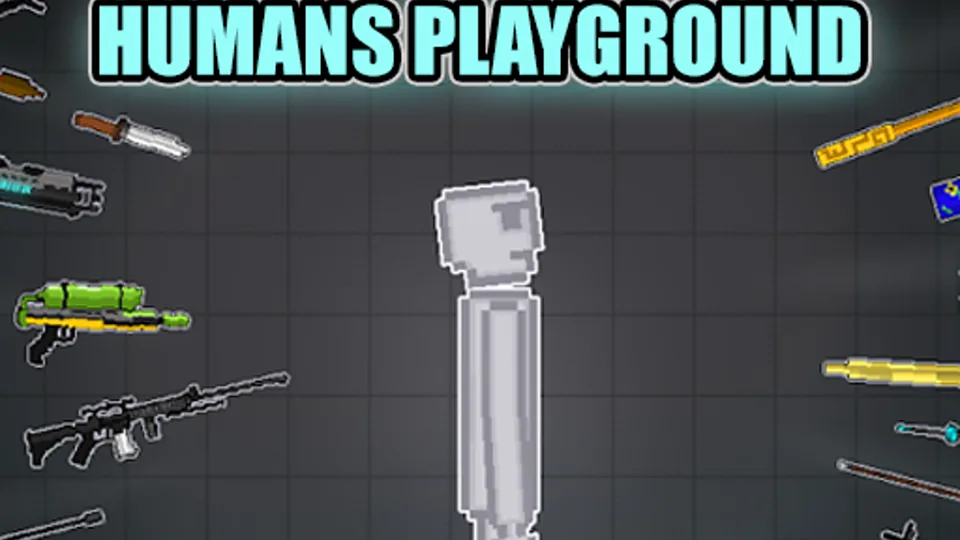
Humans Playground is a physics sandbox where you use mouse-driven tools, objects, characters, and open space to stage ragdoll experiments.
Open Physics Experiment Space
Humans Playground is a physics sandbox about creating small experiments, watching ragdoll reactions, and combining objects until the scene behaves in an unexpected way. It belongs to the same broad family as Ragdoll Playground, People Playground-style sandboxes, and tool-driven physics labs, but the useful way to understand the game is simple: there is no campaign to finish, no score target to chase, and no single correct solution. You are given an open space, interactive characters, tools, objects, and the freedom to make your own scenario.
The game plays like a physics-based sandbox simulation set in a large open space. Interaction is mouse-driven: move the cursor, click with the left mouse button, select characters, drag them into place, aim, throw objects, activate tools, and explore the workspace by pushing toward its edges. The whole setup points toward the same core identity: an open environment where you create, experiment, and break setups apart with physics rather than follow missions.
That means Humans Playground should not be read as a platformer, shooter, or mission game. It is closer to a toy box with a physics engine. The value comes from asking "what happens if" and then testing the answer. What happens if a character is placed on a moving vehicle? What happens if a machine activates at the wrong moment? What happens if two tools are connected into a chain reaction? The game does not need to judge the experiment because the visible result is the feedback.
The content can become intense depending on what tools the player chooses, so it is best approached as a ragdoll sandbox rather than a cartoon challenge for every age. The useful framing is not to glorify harm, but to explain the system: players manipulate simulated bodies and objects to observe physics, timing, collisions, and chain reactions. Humans Playground is about systems responding to player-built setups.
Tools, Ragdolls, and Chain Reactions
The core loop starts with a blank or mostly open scene. You choose an object, place it, select or drag a character, then add another tool that changes the situation. A tiny experiment might be as simple as dropping an object from height. A larger experiment might involve a vehicle, a trap, a machine, a timed activation, and several objects arranged so one event causes the next. Because the game has no fixed mission, progress is measured by how clearly your setup expresses the idea you had in mind.
The controls are mostly mouse-led. Click to interact, move the cursor over a character or object to select it, drag to reposition, aim and click when throwing or launching something, and use available tool or object menus when they are shown. Some versions also describe scroll wheels or keyboard shortcuts for switching tools and navigating the workspace. The exact interface can vary by release, but the design intent is consistent: the mouse is the hand, and the screen is the table.
A good first session should avoid overbuilding. Pick one character and one object. Move them. Drop something. Activate a simple tool. Learn how weight, momentum, collision, and distance feel in this version. Then add one new part. This matters because sandbox games become confusing when too many objects are introduced before the baseline physics are understood. When an experiment fails, the useful diagnosis is placement, timing, object choice, or the physics engine itself.
The tool set is the source of variety. Simple tools, machines, vehicles, traps, projectiles, materials, explosives, and heavier equipment all push the scene in different directions. Some items create motion. Some apply force. Some trigger reactions. Some are best used as obstacles or targets. A satisfying setup usually combines at least two categories: a vehicle carrying something unstable, a trap activated by motion, a projectile interacting with a structure, or a machine creating a timed sequence.
Humans Playground also rewards observation. Ragdoll physics can look chaotic, but the results are not pure randomness. Heavy objects fall differently from light ones. Loose bodies react differently from pinned or supported bodies. A structure that looks stable may collapse when force enters from the wrong angle. A chain reaction may fail because one object starts too far away or because a trigger fires too early. The player's job is to read those outcomes and adjust the next test.
Ragdolls, Machines, and Scenario Logic
Humans Playground is a ragdoll sandbox similar to People Playground, Melon Sandbox, or Ragdoll Playground. It is not a traditional level game. It is an open-ended physics playground with mouse interaction, simulated characters, tools, machines, vehicles, and player-made scenarios.
The loop is building experiments rather than completing levels: arrange objects, test cause and effect, watch a contraption fail, then rebuild it with a cleaner trigger. The sandbox starts directly without depending on an account gate, tutorial ladder, or long progression system before the physics can become interesting.
Explicit goals are not the structure. There is no campaign telling the scene what to do next. The best way to use the sandbox is to bring a question into the scene: can this vehicle cross the area, can this machine launch an object reliably, can a trap be triggered from a distance, can a chain reaction happen in three steps instead of one? Once the question exists, the sandbox supplies the answer.
Humans Playground also differs from many building games because it is not mainly about beauty. You can construct scenes, but the real focus is interaction. A perfect-looking setup is less interesting than one that does something. A messy contraption that moves, collapses, launches, burns, breaks, carries, or triggers a sequence has more gameplay value than a neat static arrangement. That is why the game belongs in the physics category rather than a pure decoration or city-building category.
There is an important genre boundary. The ragdoll sandbox genre often includes simulated violence and harsh physical reactions. Humans Playground works best as a systems toy: the useful focus is how forces, tools, and objects interact, not shock for its own sake.
Clean Test Setup Habits
Start with a small test. Select one character, drag it, drop it, then interact with one object. Learn how the game handles selection before adding more parts. If you immediately fill the scene, the controls become harder to read and the first experiment becomes noise.
Change one variable at a time. If a setup fails, do not move every object and switch every tool at once. Adjust the distance, then test. Adjust the timing, then test. Change the tool, then test. This is the same habit that makes real physics toys understandable: isolate the cause before judging the effect.
Use the edges of the space. Moving the cursor toward the outer boundaries helps you explore beyond the crowded center, which matters because experiments interfere with each other when every object is stacked in one place. Spread out simple tests, keep a clear workspace, and reset when the scene becomes too messy to learn from.
Finally, build around a verb. Launch, drop, pull, trap, carry, push, rotate, protect, collapse, or trigger. A sandbox with no mission becomes much easier when your experiment has a verb attached to it. In Humans Playground, the best ideas are not necessarily the biggest. They are the ones where the physics result clearly answers what you tried to make happen.
Vehicles and machines become more readable when they are tested separately before being placed into a larger scene. A vehicle should first prove that it can move without flipping. A launcher should first prove that it can send an object in a repeatable direction. A trap should first prove that the trigger fires at the intended moment. Once each part works alone, combining them becomes design instead of chaos.
The same rule applies to weapons and destructive tools. A projectile test should start with distance and angle, not with a crowded pile of objects. A fire or explosive test should start with a clear target and enough empty space to observe the chain reaction. A structure test should start with supports, then add weight, then add force. Humans Playground becomes deeper when the scene is treated as a lab bench: one hypothesis, one change, one visible result.