Gun Mayhem Online
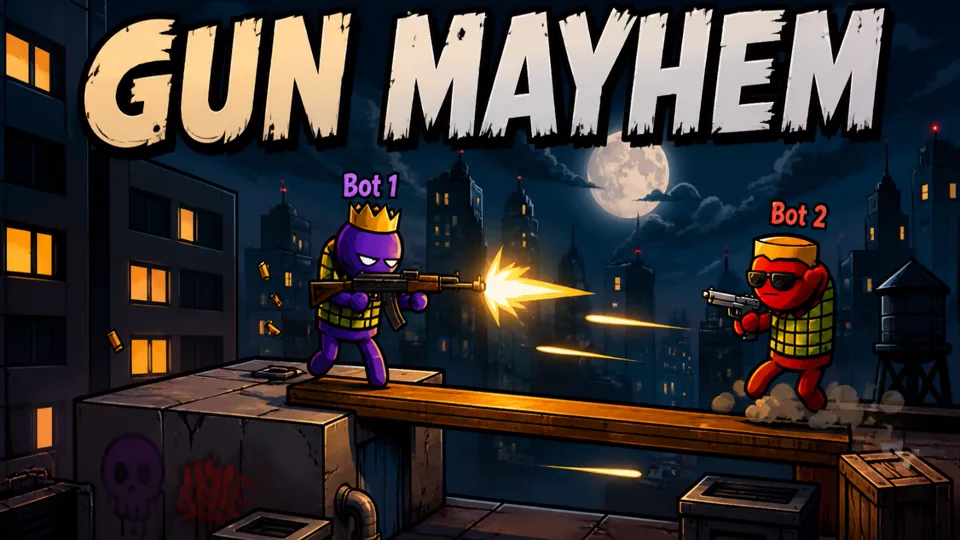
Gun Mayhem is a fast platform shooter where knockback, arena position, perks, weapon crates, bombs, and local multiplayer pressure decide each fight.
Knockback Is the Real Health Bar
Gun Mayhem is a Flash-era platform shooter associated with Kevin Gu, built around small arena gunfights where the real system is knockback. You do not simply empty a health bar until an opponent disappears. You shoot, bomb, and pressure rivals until they are blasted off the platform and cannot recover. That makes the game closer to an arena brawler with guns than to a conventional shooter.
This single rule gives Gun Mayhem its staying power. A player can survive many hits if they hold center stage and recover well. The same player can lose instantly after one badly timed jump near an edge. Damage still matters because higher damage makes later hits launch farther, but position decides when that damage becomes fatal. Every round is a small argument over space: who controls the middle, who gets forced toward a gap, who grabs the next weapon crate safely, and who wastes a bomb too close to their own feet.
The game supports two main structures. Campaign mode sends you through AI fights across themed arenas, with layouts that change how much recovery room you have. Custom Game lets you shape local rules, including Last Man Standing and one-hit variants. Many versions support up to four players on the same keyboard, which is why Gun Mayhem still works as a compact party game.
That restart speed is part of the design. A bad round does not feel like a long failure; it feels like a lesson in spacing. You learn that a crate was not safe, that a bomb was thrown too low, that a jump exposed recovery, or that a perk did not match your movement style. Gun Mayhem is old-school because it expects the player to learn by repeating short fights, not by reading long tutorials or unlocking complicated systems.
Campaigns, Custom Rules, and Fighter Setup
Before a fight, Gun Mayhem usually lets you customize a character with a hat, shirt, handgun, and perk. The cosmetic choices give each fighter a quick identity, while the perk changes the way the round feels. Perks such as extra speed, no recoil, and extra ammo sound small, but they matter because Gun Mayhem is decided by recovery windows. Extra speed can save a falling fighter or help secure a crate. Reduced recoil can keep aim stable during platform pressure. Extra ammo can turn a short exchange into enough damage to push an opponent over the edge.
Campaign mode is best for learning this relationship between damage and space. AI opponents punish obvious movement, but they also give enough repetition to learn how each arena behaves. Some maps are narrow and dangerous because every hit carries edge risk. Others offer side platforms, walls, or wider center areas that reward patience. The point is not just to shoot first; it is to understand where a shot matters. A clean hit in the middle may only add damage. A weaker hit near a gap may end the round.
Custom Game changes the psychology. Last Man Standing rewards survival and restraint. One-hit rules make every opening dangerous, because a single mistake near an edge can erase a player before their weapon advantage matters. Longer custom matches are better for new groups because they allow recovery, crate learning, and weapon experiments. Shorter rules are better for experienced players who already understand spacing and want instant tension.
The weapon list is broad, with references to more than 60 guns across categories such as submachine guns, shotguns, snipers, assault rifles, light machine guns, specials, and handguns. What matters is the weapon role. Shotguns punish close edge fights. Machine guns pressure recovering opponents. Sniper-style weapons reward clean timing but can be risky if enemies close distance.
The Gun Library is useful because it lets players test those roles without waiting for a perfect crate drop during a serious match. A weapon that feels strong in the middle of a platform may be awkward on a map with gaps. A slow weapon can be powerful if you already control distance, but terrible if a rival is jumping over you. A rapid weapon may not finish a round immediately, yet it can build damage until one later hit becomes decisive. Testing weapons separately makes Campaign and Custom Game less random because you recognize what a pickup wants from you.
Chapter progression also matters. Early Campaign fights teach movement and basic launching. Later fights become less forgiving because opponents and arenas demand cleaner recovery, better crate timing, and fewer panic jumps. Treat each chapter as a stage lesson. If a fight keeps failing, ask which rule the arena is teaching: hold the middle, avoid low platforms, punish jumps, save bombs, or stop chasing crates near the edge.
Crates Decide the Middle of the Match
Weapon crates and support drops create the second layer of Gun Mayhem. They are valuable because a better gun or temporary advantage can flip a fight, but they are also bait. If a crate lands near the edge, the player who rushes first may become the easiest target. If it lands in the middle, controlling space before grabbing it is usually smarter than sprinting directly into crossfire.
This is where Gun Mayhem becomes more tactical than its chaotic visuals suggest. The best player in a round is often not the one firing constantly. It is the one who knows when to stop chasing, when to keep center control, and when to let a dangerous crate remain unclaimed until the enemy commits. A weapon upgrade matters only if you can pick it up without losing recovery space.
Core habits that improve matches:
The standard controls reinforce the game's local-multiplayer roots. Player 1 commonly uses arrow keys to move, left bracket to shoot, and right bracket to bomb. Player 2 often uses WASD, T, and Y. Additional players can use numpad layouts. These bindings feel unusual until you understand the design: four people can fight from one keyboard without needing a separate controller setup. Before a serious match, each player should test movement, shooting, bombing, and jumping for a few seconds so nobody loses because their hand position is wrong.
Shared-keyboard games depend on fairness before chaos. Once everyone knows their movement, shoot, bomb, and jump inputs, the chaos becomes earned.
Key Highlights
- Hold center stage when your damage is high, because recovery distance matters more than trading shots.
- Push high-damage opponents toward edges before spending bombs.
- Treat crates near gaps as traps unless the opponent is too far away to punish.
- Jump unpredictably, but do not jump so often that you lose control of landing space.
- Fire diagonally across platforms when the map allows it; side pressure is often safer than direct pursuit.
- Keep bombs for edge pressure, recovery denial, or forcing an opponent to abandon a strong position.
Winning by Space, Not Panic
Gun Mayhem rewards calm movement more than frantic shooting. Beginners usually chase every crate, fire at any target, and use bombs as soon as they are available. That creates exciting rounds, but also easy losses. A damaged fighter who panics near the edge becomes a gift.
Better play starts with survival geometry. Stand where a hit will not immediately remove you. When your damage number rises, retreat toward stable platforms instead of trading from the edge. When an opponent is damaged, move the fight outward and use bullets to shape their path. Bombs are strongest when they deny a return route or punish a predictable landing, not when thrown into the middle just because the key is available.
Campaign mode teaches these lessons gradually, but Custom Game exposes them faster because human opponents adapt. A friend who keeps winning may not be aiming better; they may simply be refusing bad positions. They wait for others to fight over crates, then punish the winner while the pickup animation or movement line is exposed. They let weaker weapons do enough chip damage before committing to a launch. They jump less dramatically but land in safer spots.
That is the useful way to understand Gun Mayhem. It is not a realistic firearm game and it is not a deep progression RPG. It is a compact platform shooter where guns are tools for moving bodies through space. Once that clicks, every map becomes readable. Damage builds threat, crates create temptation, perks adjust rhythm, and the edge is always the final enemy. Win the middle, choose safe pickups, and make the opponent fall before you do.
A strong first-hour plan is simple. Play a few Campaign chapters to learn recovery. Visit the Gun Library or weapon practice options if available, then test which weapons fit close pressure, long angles, and edge control. After that, run Custom Game with forgiving rules before harsher one-hit setups. Gun Mayhem gets better when every player understands the goal: make the next hit happen where recovery is impossible.