


Gourdlets Online
Gourdlets is a cozy town-building sandbox about arranging an island community for tiny vegetable citizens with no scores, currency, or fail states.
Cozy Island Diorama
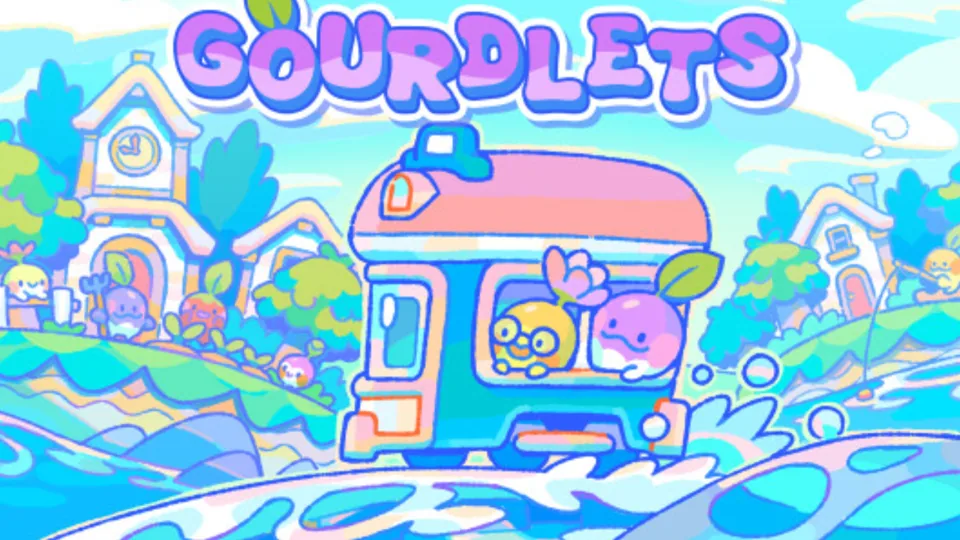
Gourdlets is a cozy town-building sandbox by AuntyGames, published by Future Friends Games and AuntyGames. The full Steam version released on August 15, 2024, after an earlier itch.io build introduced the basic idea: place buildings and scenery, then watch visiting gourdlets arrive and interact with the world. The central promise is unusually gentle for anything labeled as a city builder. There are no objectives to clear, no points to optimize, no money system deciding what you can afford, and no fail state waiting for a poorly planned town.
A train brings the first batch of gourdlet citizens to a new island home, and you decide what that home becomes. It can be a beach village, a cafe street, a lighthouse town, a park, a campsite, a cluster of tiny shops, or a strange little neighborhood that exists only because the objects look good together. The gourdlets are not demanding mayors or unhappy workers. They are tiny vegetable residents who will make themselves comfortable in whatever kind of place you build.
That distinction matters. Many town games say they are relaxing but still use pressure in disguise: resource timers, approval meters, upgrade chains, zoning requirements, or hidden efficiency math. Gourdlets is closer to a living diorama. Construction exists because the place itself is pleasant to shape, not because a quest list declares the town incomplete. The result is a low-stress sandbox, a cozy decoration game, and a background-friendly builder that remains pleasant to observe after the active placement work is done.
Placement, Interiors, and Observation
The core loop is placement, decoration, and observation. You choose buildings, paths, fences, planters, fountains, lights, furniture, and scenery props, then watch how the gourdlets wander through the spaces you made. Steam emphasizes the catalog range from cafes and lighthouses to planters and fountains, while the original itch.io listing presents the same foundation in simpler terms: build scenery, let visitors arrive, and watch them interact. That gives the game a clean design spine. It is not about unlocking the correct industry chain. It is about giving the citizens enough interesting places to sit, fish, read, camp, snooze, and generally inhabit the island.
Buildings are more than exterior shells. You can go inside and arrange furniture, which gives the game a second layer of composition. A small house can become a reading nook, a cafe can be laid out around tables and counters, and a decorative building can be treated like a tiny room scene instead of a static map tile. Interior decorating is especially important because it changes the player's relationship with scale. Outside, the island reads like a town plan. Inside, the game becomes a room designer where individual chairs, lamps, beds, and objects carry the mood.
The lack of currency changes the whole rhythm. There is no penalty for placing a fountain too early, no need to grind for the next building, and no reason to cram objects together for economic output. You can experiment with a path shape, delete it, rebuild it around a lake, move a cafe closer to a plaza, or make a lighthouse area just because the coastline looks empty. Good play is not measured by a score. Good play is when the town starts to feel legible: routes connect, empty spaces have purpose, and the gourdlets' tiny routines make the island look lived in.
The Steam version also supports a more ambient mode of play: full screen for active design, or an idle-style window mode where the gourdlets can hang out at the bottom of the desktop while other work continues. That detail explains the cozy-game pull: background companionship matters as much as construction. It is not only a place to build; it is a little animated scene that can stay around.
Key Highlights
- Shape the island first with paths, water edges, grass, sand, and open space.
- Add buildings around readable routes instead of scattering them randomly.
- Go inside buildings and furnish rooms so they feel like houses, cafes, shops, or quiet hideaways.
- Use accessories and visual details to give individual gourdlet citizens more personality.
- Adjust weather, day-night mood, and starter maps for a different creative constraint.
- Let the town run for a while after big edits so you can see where the gourdlets naturally gather.
Decoration-First Town Design
Gourdlets is a low-pressure cozy builder, and the kind of "builder" matters. The answer is simple: it is a decoration-forward sandbox, not a management sim. Its center is choosing where objects belong, arranging small scenes, and watching characters animate the result. It shares the mood of cozy village games, miniature diorama tools, casual sandbox builders, and pixel-art spaces built for creation without constant instruction.
Townmaking here is about atmosphere rather than beating a challenge. Each session can become a small design exercise: a seaside rest stop, a garden path, a cafe block, a lighthouse overlook, or an interior that looks like somebody has just stepped away from a book. The gourdlets give feedback through behavior rather than numbers. When they gather near water, sit around camp areas, or wander through the paths you drew, the town starts to answer back.
Combat, deep progression, survival pressure, and strategic management are deliberately absent. There is no economy to master and no hard win condition to prove that a layout is correct. That is not missing content; it is the point of the design. The game removes the usual pressure systems so composition, mood, and observation become the center.
The itch.io release began as a Godot-made build controlled with keyboard and mouse, while the Steam release is the fuller desktop product with the larger feature list. That history helps explain the game's shape: a small cozy idea grew into a broader town toy with interiors, object variety, citizen details, weather, and idle observation.
Small-Town Building Habits
For the best first session, build a small neighborhood instead of trying to fill the whole island. One path, two houses, a shared park, and a decorated interior will teach you more than a huge empty map. Place objects in clusters so the gourdlets have readable destinations. A bench beside a path, a planter near a doorway, a fountain in a plaza, or a campsite near open ground gives the town more personality than a row of unrelated decorations.
Use interiors early. New players often focus on the outside map because the town view is immediately visible, but the ability to furnish buildings is one of the game's best sources of personality. A plain structure becomes memorable when it has a purpose inside. Try building one house as a bedroom, one as a cafe, and one as a quiet reading room. Then return outside and connect them with paths, fencing, and outdoor props.
Change weather, time-of-day mood, or starter maps when the first layout starts to feel solved. Those tools are not progression gates; they are creative prompts. A rainy town wants different lighting than a sunny one. A night scene benefits from tighter clusters and visible gathering places. A different starting island can push you toward a new route shape instead of repeating the same village plan.
Most importantly, stop and watch after every major edit. Gourdlets works because the residents turn a layout into a place. If nobody seems to use a corner, simplify it or give it a clearer object focus. If a plaza looks good when several gourdlets pass through, build outward from that success. The game has no scoreboard, so the real measure is whether the town feels pleasant enough that you want to leave it running for a while.