








Escape From Prison Multiplayer Online
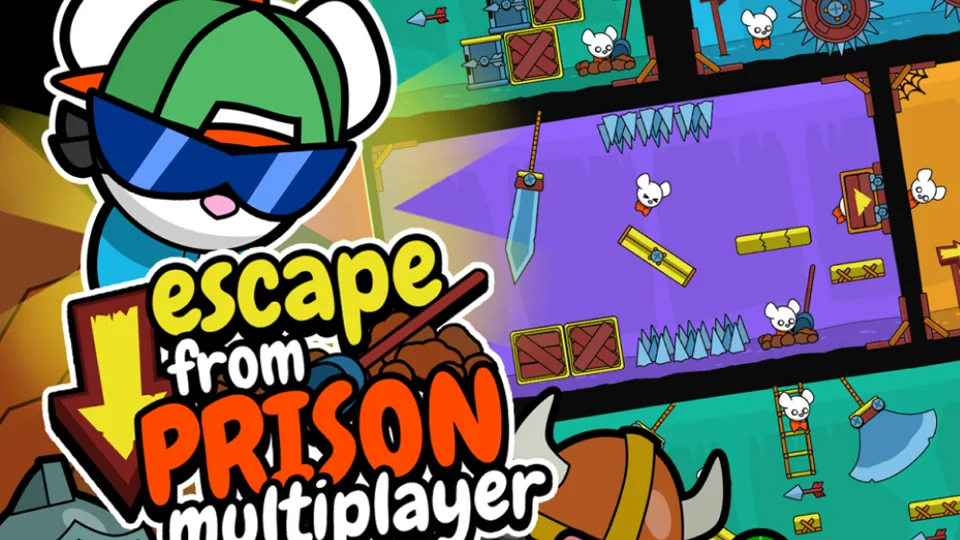
Escape From Prison Multiplayer is a Dinobros obstacle-race platformer where a tiny custom mouse escapes trap-filled prison rooms against other runners.
Tiny Mouse, Big Prison Race
Escape From Prison Multiplayer is a multiplayer platformer about a small mouse breaking out of a trap-filled prison. The premise is playful, but the structure is serious: customize the mouse, enter a room, read the hazard pattern, jump cleanly, and reach the next exit before rival runners turn the same room into a race.
That directness is the appeal. The mouse can be understood instantly, the prison goal is obvious, and the controls are intentionally spare: WASD or arrow keys to move, Space to jump. On touch devices, the same idea is mapped to movement and jump buttons. Because the command set is small, mistakes are honest. You jumped too early, drifted too far, panicked behind another player, or failed to watch the trap cycle.
The 2D room structure stays readable even when the course is crowded. The mouse has a small silhouette, hazards usually communicate through clear movement cycles, and the exit goal stays simple enough that the player can spend attention on timing. The challenge is not remembering complex commands. The challenge is staying calm when the next jump must be made while other runners are landing, missing, or blocking the visual line.
The prison theme works because it gives the course a clear direction. Each cleared room feels like another step toward freedom, but the real challenge is not a story puzzle. It is a sequence of movement checks: enter the room, identify the first trap, watch the cycle, commit to the jump, and recover quickly enough for the next hazard. The best runs feel smooth because the player is always preparing for the obstacle after the current one.
Rooms Are Timing Puzzles
Each prison room works like a small timing puzzle. A straight hallway may teach movement. A gap teaches jump height. Lasers teach patience. Blades teach cycle reading. Moving platforms teach commitment. Spikes and collapsing floors punish sloppy landings. Later rooms become more interesting by combining hazards, so one delay changes the timing of the next obstacle.
The best way to improve is to stop treating every room as a sprint. Speed matters, but only after the route is clean. If a blade moves in a regular cycle, watch one pass before crossing. If a laser turns on and off, decide whether the safe window is wide enough before jumping. If a platform moves away from you, do not leap just because another player leapt; their timing may be wrong for your position.
Multiplayer makes the same hazards feel sharper. Other runners can block your view, tempt you into bad timing, or create pressure simply by pulling ahead. Good players use them as information, not instructions. If someone clears a trap smoothly, notice the rhythm. If someone crashes, keep your own line. The prison only needs one mistake to steal the room; copying a stranger's mistake gives it that mistake for free.
Crowded rooms reward lane discipline. If three players enter a narrow jump at once, the safest move may be waiting half a beat so your mouse is visible again. If a rival jumps early and clips a trap, do not inherit their panic. If a leading player crosses cleanly, use the timing as a clue but still adjust for your own starting position. Multiplayer pressure is useful only when it gives information; it becomes harmful when it turns your run into imitation.
Mobile controls follow the same idea with on-screen movement and jump buttons. The difference is finger placement. Keep the jump input reachable without covering the mouse, and avoid making long presses when the room needs a small correction. On a keyboard, oversteering is usually the mistake. On touch controls, late jumps and covered vision are often the problem. The route is the same, but the control discipline changes.
Useful escape habits:
Key Highlights
- Watch each new trap for one cycle before committing.
- Use small jumps for short gaps so the landing stays controlled.
- Pause before blades and lasers when the cycle is unclear.
- Keep your mouse visible by choosing a custom look you can track.
- Ignore leaderboard pressure until the room route is reliable.
- Learn which hazards require waiting and which reward immediate movement.
- Treat each failure as one route correction, not a reason to mash faster.
Customization Helps More Than It Looks
The customizable mouse is not just decoration. In a multiplayer platformer, visual clarity matters. Several players can overlap on the same ladder, gap, or corridor. If your mouse blends into the group, it becomes harder to judge jump timing and landing position. A distinctive look helps you keep focus when the room gets crowded.
Consistency also helps. Constantly changing the avatar may be fun, but using one familiar look during harder rooms makes movement easier to read. You learn how far the character appears to travel, where its feet line up with ledges, and how it looks mid-jump. Those tiny readings matter when the next obstacle is a blade, spike, or moving platform.
Customization also reinforces the party-race mood. Escape From Prison Multiplayer is not trying to be a grim prison simulator. It is a bright obstacle course where a silly prisoner mouse can still produce real tension because every missed jump costs time. The tone stays light; the execution still demands precision.
Leaderboard Pressure Changes Decisions
Leaderboards turn clean movement into a repeatable challenge. A first clear teaches the layout. A better clear trims hesitation. A leaderboard run asks you to keep the same route under pressure. That pressure changes decisions because a player trying to shave time may attempt jumps they would not take during a safe run.
The important distinction is risk quality. A smart risk is based on room knowledge: you know the laser cycle, you know the platform position, and you know the jump can land. A bad risk is emotional: another player passed you, so you jumped without checking. The first kind can improve a time. The second kind usually resets the room.
The time-race structure also changes how you should read a failure. A failed jump near the start usually says your opening route is not stable yet. A failed jump near the end often says fatigue or leaderboard pressure made you rush an obstacle you already understood. Separate those two problems. Practice the opening if you are losing immediately. Slow down the final sequence if the first half is clean and the last trap keeps stealing the run.
Racing also makes recovery important. Falling behind early does not always decide the run. Other players still have to clear later rooms, and harder obstacle combinations punish impatience. If you lose a few seconds, return to the clean route instead of trying to win the whole race with one desperate jump. A stable second half often beats a reckless opening.
This is where the party feel and the skill ceiling meet. A room full of mice looks silly, but the timing questions are real. Someone else's mistake can hide your character, trigger your panic, or tempt you into a bad jump. Someone else's clean run can also reveal the correct rhythm. The trick is to treat every other player as moving information, not as a command to copy.
Clean First, Fast Second
For a first session, ignore the scoreboard for a few rooms. Learn acceleration, jump height, and how much air control the mouse has. Find out whether a platform needs an early jump, a late jump, or a wait. Identify the room sections where you lose visibility because other players overlap. These details are more valuable than one lucky fast clear.
After the route is known, start tightening. Remove pauses from hazards you understand. Jump earlier only when the landing stays safe. Take sharper lines only where the floor is wide enough. If a shortcut causes repeated failures, it is not a shortcut yet. It becomes one only after the timing is consistent.
Escape From Prison Multiplayer works because its design is honest. The controls are simple, the goal is clear, and the prison rooms punish exactly the mistake you made. The strongest runs do not come from frantic input. They come from reading the hazard, committing at the right moment, and refusing to let multiplayer pressure pull you off your own rhythm.
A good improvement path is to choose one recurring failure and fix only that. If lasers keep catching you, practice waiting for the full cycle. If moving platforms keep leaving without you, jump earlier but land with less drift. If crowded rooms make you lose sight of the mouse, use a more visible custom look and let the first rush pass. Fast escape times are built from those small corrections, not from trying to force every room at maximum speed.