







Escape Animals Online
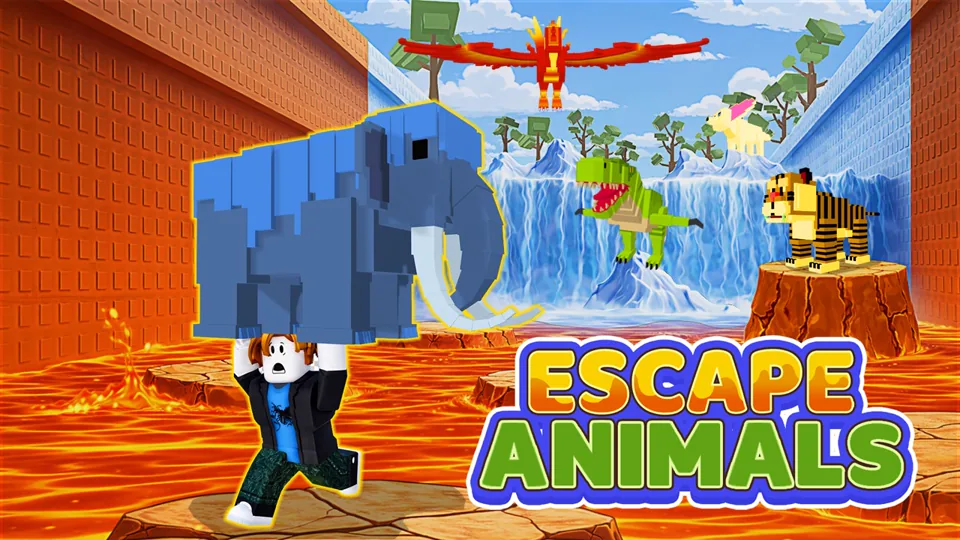
Escape Animals is a survival collection arcade game where you rescue 60 animals across 7 rarity levels, bring them home, and upgrade a base that keeps earning.
Rescue Runs Under Rising Danger
Escape Animals is a survival collection arcade game about making rescue runs, deciding when greed becomes a mistake, and turning saved animals into a stronger base economy. The name can sound like a simple animal platformer, but the actual loop is sharper: leave home, cross dangerous zones, pick up animals, avoid hazards, return before the run collapses, then use the rescued animals and earned money to upgrade future attempts.
The threat layer mixes rising lava, dangerous ice, giant waves or tsunami-like pressure, and increasingly difficult zones. The collection layer adds 60 collectible creatures across 7 rarity levels, map events such as cosmic or celestial rewards, passive earnings from rescued animals, upgrades for speed and carrying capacity, base slots, shop choices, a lucky wheel, an index, and rebirth mechanics that reset progress for permanent bonuses. Those systems make Escape Animals more than an obstacle course. It is a risk economy.
The central question is always the same: should you rescue one more animal or go home now? Returning too early is safe but slow. Staying too long can cost the animal in your hands and waste the route. The best players learn to judge distance, hazard speed, animal value, carry capacity, and the upgrade they are trying to afford. A run is successful when it serves a purpose, not when it blindly reaches the farthest point.
That purpose changes over time. Early runs should collect nearby animals because movement speed is low and carrying power is weak. Later runs can push deeper for rarer animals because upgrades make retreats safer. Once the base earns steady money, targeted collection becomes more important than grabbing whatever is closest. A missing rare animal, special event target, or high-income creature can justify more risk than a common rescue.
Animal Value and Base Income
The base is the reason each rescue matters. Animals brought home generate income over time, turning short action runs into long-term progression. A rescued animal is not only a score item; it becomes a worker in the economy. More valuable animals improve earnings, more slots expand capacity, and better upgrades let future routes reach farther zones. This creates a loop where movement skill and management decisions feed each other.
Animal rarity gives routes a second layer. A 60-creature roster spread across 7 rarity tiers means early progress is not just "collect animals" in a generic sense. The collection has structure. Common animals are useful for starting income, but rarer animals can change the value of a run. When cosmic, celestial, money, secret, or divine-style events appear, the best target may move from the closest safe pickup to a rarer or time-limited route.
Speed upgrades are usually the safest first investment because speed improves every part of the loop: reaching animals, escaping hazards, correcting a bad path, and returning home before danger catches up. Carry upgrades become stronger after you can reliably reach animal zones. Carrying more means fewer return trips, but it only helps if you can still get home. Jump and strength-style upgrades matter once the arena starts asking for larger gaps, heavier catches, or tougher route pressure. Base-slot upgrades matter when good animals are waiting but the home area cannot hold enough value.
Rebirth should be treated as a strategic reset, not a panic button. Its value comes from permanent benefits such as income multipliers, jump bonuses, or other scaling boosts. That makes it useful when normal progress slows and the next reset will clearly improve future runs. Pressing it too early can erase momentum before the base has generated enough value. Waiting too long can stall scaling. The right timing depends on whether the permanent reward meaningfully improves the next cycle.
Controls as Progression Tools
Escape Animals has more controls than a simple runner, and each one exists because the game combines movement, collecting, menu management, and upgrades. WASD or Arrow keys move. Spacebar jumps when the build supports jumping. E handles animal collection or interaction. R can trigger rebirth or revive-style reset flow when that option is active. F may upgrade speed or carrying capacity. V opens shop options. H returns attention to the base. T opens lucky wheel rewards. C opens the animal index. P handles settings. G throws or drops a carried item. Mouse controls can select, attack, or adjust camera depending on the version.
The throw or drop command deserves attention. Beginners often force a bad return because they are holding a low-value animal or the wrong target. Dropping the item can save a route if a better animal appears or if carrying weight slows the retreat. It is not always correct, but it gives the player a way to recover from a poor pickup instead of accepting a weak run.
The index is a planning tool. A collection game becomes stronger when the player knows what is missing. Use the index to understand which animals have already been secured, which rarities remain, and which zones may deserve attention. Once the base earns enough income, repeating the nearest route forever becomes inefficient. Targeted collection creates better long-term progress.
The lucky wheel and shop should support the rescue loop rather than distract from it. If a reward improves speed, carry, income, or base capacity, it can change the next route. If the shop offers a cosmetic or optional bonus, decide whether it solves the current bottleneck. The best spending choice answers a specific problem: too slow, too little carry, too few slots, weak income, or poor event access.
The event system is worth treating as route pressure, not background decoration. A money event can make base upgrades arrive faster. A rare animal event can justify a deeper push. A changing map can make a familiar path less safe. The correct response is not always "run farther." Sometimes the best event play is to bank a strong animal, upgrade, then make the deeper attempt with better speed or capacity.
Smarter Retreat Timing
The first practical rule is to return before danger becomes visible if the animal is valuable. If you are holding a common low-value animal near the base, a little greed may be acceptable. If you are holding a rare animal far from home, the correct move is often to bank it immediately. The loss of a good rescue hurts more than the benefit of one extra risky pickup.
The second rule is to match route depth to upgrades. A slow runner should farm nearby zones. A faster runner can reach farther animals. A high-carry runner can chain pickups only after the retreat path is known. A rebirth-boosted runner can take risks that would have been foolish earlier. Escape Animals becomes much easier when ambition grows after the stats support it.
The third rule is to learn hazard behavior. Lava, ice, waves, and other threats punish different habits. Lava-like pressure often rewards early retreat and clear routes. Ice can punish sharp turns or careless movement. Giant wave pressure makes distance from home more dangerous. Jumping can bypass some animal-body traffic or small obstacles, but it should not become an excuse to ignore route safety. If a failed run comes from the same hazard repeatedly, the next upgrade or route should address that hazard directly.
Escape Animals combines survival running, animal collection, base building, passive income, upgrade loops, and short sessions with visible improvement. It is not a pure puzzle game with one designed solution, and it is not an idle game where movement barely matters. Its best identity is hybrid: action decisions during each run, management decisions between runs, and collection decisions across the whole progression curve.
Start with nearby rescues, invest in speed, then carry, then jump or strength when the route demands it, then slots and income. Use the index to set collection targets, use shops and wheel rewards to solve bottlenecks, and treat rebirth as a deliberate scaling point. The game becomes satisfying when each run has a clear answer to one question: what animal, upgrade, or permanent advantage am I trying to secure before the danger catches me?