


Cats Crash Arena Turbo Stars Online
Cats Crash Arena Turbo Stars is a physics auto-battler where you build a combat car, tune its parts, and let arena duels reveal whether the design works.
Garage Engineering Before Combat
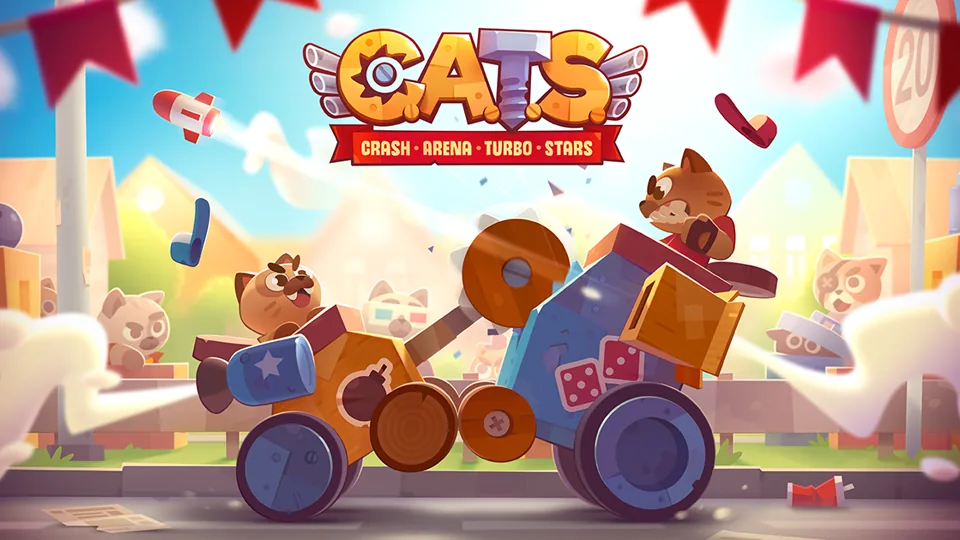
Cats Crash Arena Turbo Stars, often shortened to C.A.T.S., is a vehicle-building auto-battler about engineering a machine before the arena starts. ZeptoLab released C.A.T.S. in April 2017, and the core idea has stayed clear: a cat drives a homemade combat car, but the real game is not steering around the arena by hand. You build the machine, choose the parts, and then watch physics decide whether your design can beat the opponent.
That distinction matters. Many players expect an action racer because the screenshots show wheels, weapons, and crashes. C.A.T.S. is closer to an engineering puzzle with competitive pressure. The garage is where most of the skill lives. A strong machine needs the right body shape, wheel placement, weapon reach, gadget timing, energy budget, and weight balance. Once the fight begins, you mostly learn whether those decisions were correct.
The original C.A.T.S. framing is asynchronous PvP: you battle machines designed by real players, but the cars fight automatically. The story layer has Uncle Tony pushing an ambitious kitten into the car battles Championship, with 24 stages before the finals and world champion goal. That matters for expectation. The opponent may look strange or unfair because it is not just a handcrafted tutorial bot; it may reflect another player's garage logic, lucky parts, or matchup trick.
The first useful habit is to read the machine before chasing upgrades. Look at where the weapon sits, how high the nose rides, whether the wheels keep the body stable, and whether the car flips, stalls, lifts, pushes, or pins the enemy. A weak-looking build can win if it controls the first collision; a stronger-looking build can lose if its best part never touches the opponent.
Chassis, Wheels, Weapons, Gadgets
The core loop in Cats Crash Arena Turbo Stars is build, battle, diagnose, rebuild. You assemble a combat vehicle from a chassis, wheels, weapons, and gadgets. Then the arena match plays out as a short 1v1 duel. If the machine wins, the build probably controlled contact better than the opponent. If it loses, the replay usually explains why.
Every body is more than a shape. It has health, power capacity, attachment points, and a layout that decides what can be mounted. Large circular weapon points usually carry weapons, while smaller utility points carry gadgets. A machine can have a great weapon in inventory and still fail if the body lacks enough power or the slot places the weapon too high. This is why chassis names and shapes such as Titan, Surfer, Whale, Classic, Diamond, and similar body families become strategic vocabulary in the wider C.A.T.S. community.
Chassis choice is the foundation. A low body can wedge under opponents and lift their weapons away from the fight. A rounder or taller body may carry different slots, but it can also roll, bounce, or expose its weak side. Wheel size changes the angle of the nose and the way the car approaches contact. A large rear wheel with a smaller front wheel can push the front down; a badly placed wheel can make the car drag, flip, or lose traction. Wheels can also add health, so removing wheels for stability is not free; it may solve a flip problem while reducing durability.
Weapons create the next layer. Drills, stingers, chainsaws, blades, lasers, miniguns, shotguns, rockets, and similar tools all ask for different bodies. Drills and chainsaws need steady contact, so they work best when the body can stay pressed against the enemy. A stinger can reward forward reach if the slot is low enough. Lasers and rockets can punish enemies from a distance, yet they may lose if a wedge closes the gap too quickly. Shotgun recoil can push both machines and may even destabilize the user's own build. Recoil matters: a weapon that pushes your own machine backward can ruin a design that relies on forward pressure.
Gadgets turn a simple car into a matchup plan. Boosters help close distance or force the nose down. Harpoons can pull an opponent into a bad angle. Repulsors can pop, flip, or interrupt contact. Lifters and forklifts can beat low machines if they catch the opponent cleanly. The best builds are not just collections of high numbers; they are systems where body shape, wheel angle, weapon range, power consumption, and gadget timing all support the same idea.
Toolboxes and fusing add another layer of commitment. Improving a part can be powerful, but the resource is spent once used. That is why experienced players are careful about feeding upgrades into wheels, gadgets, or temporary parts that may be replaced quickly. Fusing into a body or weapon you actually plan to keep can make sense; scattering upgrades across random pieces often leaves the garage weaker than a focused build would have been.
Key Highlights
- Start by watching the first loss carefully instead of immediately swapping every part.
- Check whether your weapon actually touches the enemy during the first second of combat.
- Use wheel size to change the car angle, not just to raise stats.
- Build around one plan: wedge, pin, lift, burst from range, or survive long enough for damage to land.
- Expect compact versions to vary from the full mobile ecosystem, especially around events, rankings, ads, and long-term progression.
- Check energy before falling in love with a weapon; a high-damage part is useless if the body cannot power the whole build.
- Treat toolboxes as permanent decisions, not casual decorations.
Vehicle Combat Builder Logic
Cats Crash Arena Turbo Stars is not just a cat-themed battle game. It is a vehicle combat builder where the important questions are mechanical: can your weapon reach first, can your wheels hold the body at the right angle, can your gadget interrupt the opponent, and can your machine survive long enough for its plan to work?
The feedback loop is clean because small part choices produce visible outcomes. A car that loses because it flips over is not mysterious. The shape is wrong, the wheel angle is wrong, or the enemy has a tool that counters your plan. Every short match becomes useful evidence.
Direct driving is not the structure. The player is not drifting around an arena or aiming every shot manually. The work happens in the garage: body selection, wheel position, weapon reach, gadget timing, and upgrade priority. The better the physics are understood, the more the automatic fights feel like proof of the design.
The wider C.A.T.S. ecosystem adds competitive pressure through PvP battles, ranks, leaderboards, Championship progression, chests, keys, rare parts, and upgrade rewards. The full game also expands into a second Ultimate garage, Ultimate leagues, gang cooperation, City Kings competition, rotating events, and unusual fight formats. Those systems matter because they give each garage decision a longer arc. You are not only trying to win one duel; you are building a machine family that can keep improving as new bodies, wheels, weapons, and gadgets become available.
Diagnosing Each Failed Duel
Start slowly in the garage. Vehicle battlers can look chaotic once the machines collide, but most losses have one clear cause. Before changing parts, watch whether your car reaches the opponent, whether the weapon makes contact, whether the chassis stays upright, and whether a gadget fires at a useful moment.
For the best session, make one change at a time. If you replace the body, both wheels, the weapon, and the gadget after every loss, you will not know what actually fixed the problem. Change the front wheel to lower the nose. Move from a ranged weapon to a drill. Add a booster. Try a lifter. Each change should answer one question.
Pay attention to the first collision. Many C.A.T.S. fights are decided immediately by who gets under whom, whose weapon connects first, and whether a gadget changes the angle. If your machine drives under the enemy but deals no damage, your weapon slot is probably wrong. If your machine has good damage but flips over, the body and wheels are fighting your plan. If you never reach the enemy, you may need speed, traction, or a different weapon concept.
Do not chase raw stats blindly. More health, more damage, or rarer parts help, but the physics can make weaker-looking builds win. A low plow can pin a taller opponent. A booster can make a melee weapon connect before a rocket setup has time to work. A harpoon can pull an enemy into a blade or wall. A shotgun may look strong and still fail if the recoil flips the frame. The strongest machine is the one where the parts agree with each other.
When you lose, describe the failure in plain language before rebuilding: too tall, too slow, weapon too high, nose too light, flips backward, cannot reach, gets lifted, loses to ranged damage. That diagnosis is the real strategy layer of Cats Crash Arena Turbo Stars.