

Build Crush Online
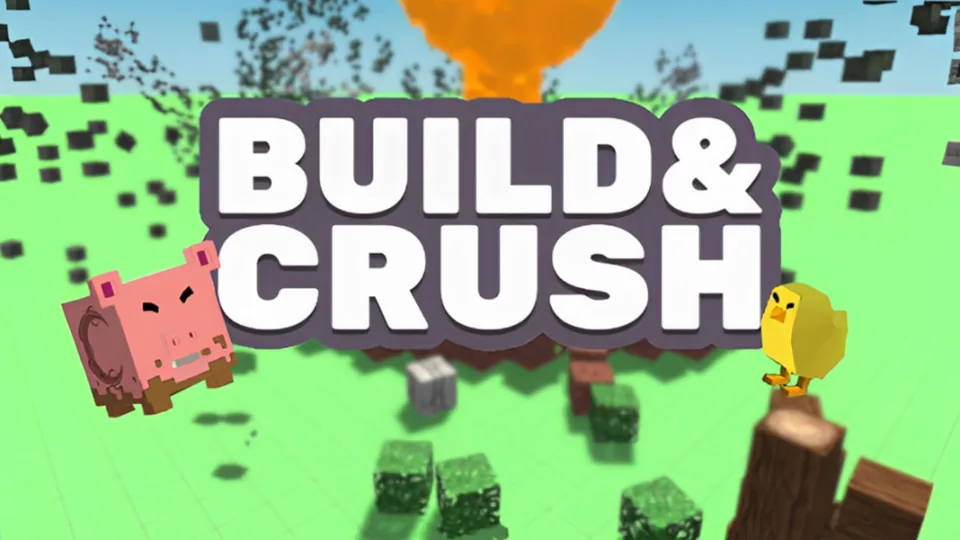
Build Crush is a block-building destruction sandbox where you create, save, publish, playtest, and tear apart voxel structures.
Build, Save, Publish, Crush
Build Crush is a block-building destruction game built around a clean two-part promise: make something, then see how it breaks. In build mode you create structures from voxel materials. In crush mode you attack creations with weapons, disasters, vehicles, and heavy impact tools. The fun is not only construction and not only demolition. It is the conversation between the two.
A tower is not finished when it looks tall. It is finished when you know how it handles cannon fire. A bridge is not finished when both sides connect. It is finished when you know whether one TNT blast takes the whole span down. A wooden house is not finished when the roof closes. It is finished when you know whether fire stays local or spreads through the shape.
That makes Build Crush more focused than a normal creative sandbox. There is no survival night cycle, hunger meter, or ore grind fighting for attention. The design asks one question again and again: what happens when the thing you made is stressed?
Building With Test Results in Mind
Build mode gives you a 3D construction space with movement, vertical flight, block placement, and block removal. WASD handles movement, Shift and Space move vertically, left click removes blocks, and right click places blocks. Those controls make roofs, tower caps, and upper bridge layers possible without temporary scaffolding.
The block set supports more than plain cubes. Normal materials include options such as brick, granite, glass, wood, leaves, and metal-like surfaces. Colored blocks help mark decorative zones, targets, team areas, or path directions. Shape variations such as stairs, columns, triangles, and other alternate forms let a build become more readable than a rectangular pile.
The editor can also support animals and obstacle pieces, which matters for maps that are meant to be played rather than only destroyed. A parkour build needs readable jumps and hazards. A destruction build needs exposed weak points. A showcase build needs recognizable silhouettes and material contrast. The same block tools can serve all three, but only if you decide the purpose before filling the space.
The stronger builds usually begin with purpose. A parkour map needs jumps, obstacles, restart points, and a readable finish route. A destruction map needs weak spots, material contrast, and satisfying collapse zones. A display build needs silhouette, color, and recognizable features. Building without purpose still works, but building with the later test in mind produces better results.
Good construction habits:
Saving matters because the crush phase can become messy quickly. A good version should be preserved before the nuke, tsunami, black hole, meteorite, cannon, or fire test begins.
Key Highlights
- Use wide foundations before adding height.
- Mix full blocks with stairs, columns, and triangles to make edges readable.
- Use colored blocks to mark routes, targets, or fragile sections.
- Save a clean version before running destructive tests.
- Change one design variable at a time when comparing results.
- Playtest parkour routes before publishing them for other players.
Crushing as Diagnosis
Crush mode turns builds into experiments. You can load creations from other players, filter by newest, best, or recommended, and jump quickly into a new target when the current one has served its purpose. That public-creation loop is important because it gives the game more variety than your own imagination alone. A stranger's parkour course, castle, statue, or trap build may reveal a demolition idea you would not have built yourself.
The tools cover different kinds of failure. TNT is local and readable, good for checking whether one room or support column can start a chain reaction. Cannons test aim, range, repeated impact, and exposed walls. Fire tests material choices, especially wood-heavy designs. Earthquakes attack the whole foundation rather than one point. Cars, soldiers, airplanes, hydraulic presses, black holes, tsunami waves, meteorites, and nukes create more theatrical stress tests when controlled damage is no longer the goal.
Free flight and random-creation controls make crushing faster to evaluate. Free flight helps inspect what survived after the first attack: a hidden basement block, a floating roof fragment, or a support column protected by the collapse. Random selection keeps the session from getting stuck on one target. The best demolition loop is quick: choose a creation, identify its structure, pick a first tool, inspect what remains, then decide whether the next weapon should finish the job or teach something new.
Do not always start with the biggest weapon. A nuke proves that almost anything can vanish. Smaller tools explain why it failed. Cannon shots reveal weak faces. TNT reveals spread paths. Fire reveals vulnerable materials. Earthquakes reveal whether a tall build has a real base or only a decorative shell. The more specific the test, the more useful the next build becomes.
Fast Crush and Parkour Change the Goal
Build Crush is not only freeform demolition. Fast Crush changes the rhythm by adding a leaderboard and limiting weapon uses. That restriction turns destruction into routing. You cannot waste every tool on the first wall. You have to decide which weapon removes the most structure fastest, which weak point starts the best collapse, and which tool should be saved for the final mass of blocks.
Fast Crush is not only about raw weapon power. It is about sequencing. A cannon shot may expose a support, TNT may open the core, and a final high-impact tool may finish the remaining block mass. If the limited-use rule is active, wasting a huge weapon on an exterior wall can lose the run. The better question is which first hit causes the most useful collapse, not which weapon looks most dramatic.
Parkour mode moves the focus from destruction to traversal. Public builds can become obstacle courses with spikes, rotating bars, springs, checkpoints, and finish routes. The Lava variant adds rising danger, so waiting too long becomes a loss condition. A good parkour build is judged differently from a demolition target: jumps must be fair, obstacles need readable timing, and checkpoints should reduce frustration without removing challenge.
Springs and checkpoints change parkour pacing. Springs create vertical routes that would be awkward with block jumps alone, while checkpoints make longer courses tolerable because one mistake does not erase the whole run. Spikes and rotating bars need spacing that lets players read the obstacle before committing. Lava mode changes that contract: a safe pause can become unsafe if the hazard keeps rising, so the builder must balance readability with pressure.
Those modes make the same editor more flexible. One build can be a pretty structure, a public map, a demolition target, or a speed challenge. The creator's job is to make the intent obvious. The player's job is to understand what the build is asking before treating every map as a pile of blocks to destroy.
Better Sessions Through One Clear Experiment
The best Build Crush sessions start with a question. Can a four-leg tower stay upright after one support is removed? Does a glass wall fail faster than a brick wall? Can a wooden roof survive if the base is stone? Will a parkour jump remain fair when lava pressure is active? That question tells you what to build and what to test.
Start small. Build a square room, save it, and test one demolition tool. Then change one thing: replace one wall with glass, raise the room on pillars, add a second floor, or make the roof heavier. If the result changes, you know why. If you change five things at once, the collapse may look exciting, but it teaches less.
When playing public creations, vote and move on when a build has taught its lesson. The Random option supplies a fresh target. Treat impressive maps as lessons in structure, route, and collapse design. Build Crush works because every broken wall feeds the next build. The game is at its best when construction is not the opposite of destruction, but the reason destruction becomes interesting.