









Backrooms Online
Backrooms is a multiplayer horror escape game about exploring liminal maze levels, staying quiet near entities, solving route puzzles, and surviving with friends.
Liminal Maze Pressure
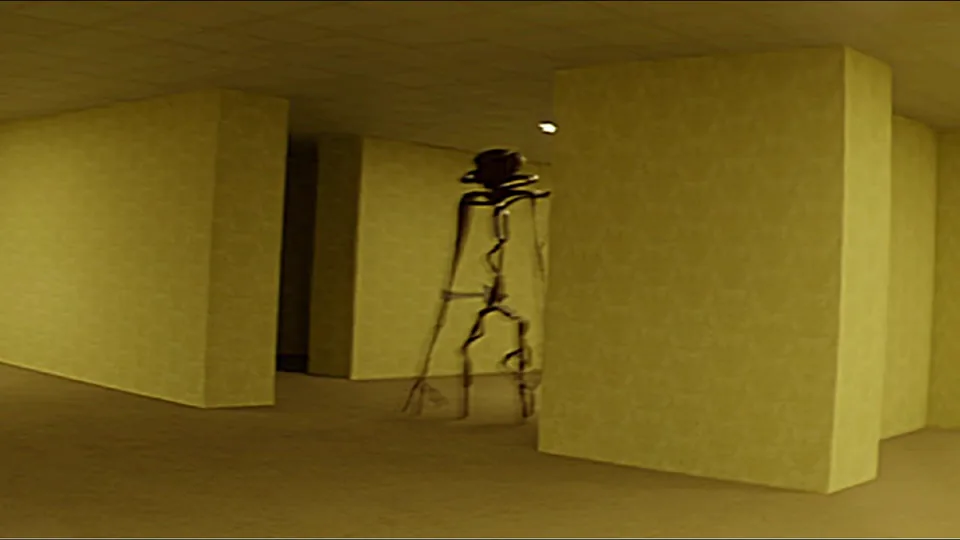
Backrooms is a multiplayer horror escape game built around a specific kind of fear: spaces that look ordinary enough to recognize, but wrong enough to destroy your confidence. Yellow rooms, old carpet, fluorescent buzzing, low ceilings, blank corridors, repeated corners, and strange doors create a maze that feels familiar at first and hostile after a few turns. The terror is not only the entity. The terror is losing the ability to trust the room.
Backrooms horror works through a repeatable set of pressure systems: endless maze-like rooms, old moist carpet, background fluorescent noise, traps, hidden items, entities, difficulty changes, and escape goals. Modern co-op versions add proximity voice chat, private rooms, level transitions, flashlights, batteries, almond water, skins, spectator cameras, and run-focused stages where stealth collapses into a sprint. Those details matter because they show why Backrooms works as a game format rather than only a creepypasta idea.
Backrooms Online-style builds often frame the experience as solo play or up-to-four-player co-op. That limit matters: four players can cover more doors and clues, but four panicked voices can also destroy orientation. Some versions advertise more than ten levels, with different mechanics, puzzles, enemies, environments, and survival demands. A level can ask for quiet navigation, a puzzle chain, an escape door, or a sudden run where crushing blocks and tight timing replace slow stealth.
The best Backrooms session begins with orientation. You are not simply walking through rooms. You are trying to build a mental map in a place designed to erase maps. Every unusual object, corridor bend, door cluster, sound change, stain, light pattern, or dead end can become a landmark. If the group ignores landmarks, the maze wins before any monster appears.
Multiplayer changes the fear. Friends can search faster, compare clues, and warn each other. They can also create noise, split too far, panic at different times, and lead danger back to someone solving a puzzle. Backrooms is scarier with company because the group creates hope and then threatens to fracture it. The moment a teammate's voice fades or a callout becomes unclear, the maze becomes larger.
Entities, Items, and Level Goals
Backrooms games usually ask players to explore, find key items, solve route or object puzzles, avoid entities, and reach a transition point before the level overwhelms them. The objective may be a door, elevator, code, portal, collected tapes, switches, keys, batteries, or another environmental requirement. The exact task changes by build, but the role is stable: the objective forces players to move through unsafe space.
Entities should be treated as pressure, not targets. Many Backrooms-inspired games are not built around fighting every threat. Survival comes from stealth, hiding, breaking line of sight, listening, and choosing when to run. IndieFist-style descriptions explicitly warn players to avoid hero behavior and hide from unknown entities. That is good advice for the genre. A player who tries to overpower the monster is usually misunderstanding the design.
Items can buy time or unlock progress. Flashlights make dark areas readable but can create dependence on battery management. Almond water appears in several Backrooms games as a recovery or support item. Batteries, keys, tapes, and clues give the player reasons to search rooms that would otherwise be avoided. The danger is tunnel vision: staring at an item prompt while an entity approaches, or collecting something without remembering the route back.
Flashlight skins and character skins are cosmetic, but the flashlight itself is not cosmetic. Light defines what the team can read, which routes feel safe, and when a dark hallway is worth entering. Batteries should be treated as a shared resource in co-op. If every player burns light at the same time, the group may reach the next puzzle with no safety margin.
Traps and environmental hazards turn navigation into more than wall-following. Holes, crushing blocks, locked routes, sudden level changes, and dead spaces force the player to slow down. A safe-looking corridor can become a mistake if nobody checks the floor, sound, or sightline. That is why a good Backrooms run alternates between movement and inspection. Walk, listen, check, call out, then move again.
Run-focused stages change the rules. A level like "Run for Your Life" is not solved by carefully sketching every hallway. It asks the team to commit, sprint, avoid crushing hazards, and accept that hesitation can be fatal. The best preparation is done before the chase starts: assign who leads, keep the group close enough to hear, and avoid blocking each other in narrow passages.
Voice Chat and Team Shape
Proximity voice chat is one of the strongest mechanics in modern Backrooms multiplayer. Nearby survivor audio turns communication into a spatial resource: close players can share clues quickly, while separated players become harder to guide and easier to lose. If you stay together, information is immediate. If you split up, search coverage improves but the team may lose reliable contact.
Good teams use short callouts. "Door left," "dead end," "entity behind," "battery here," "return to yellow room," and "hold position" are better than long panic commentary. Too much talking hides audio cues. Too little talking leaves teammates without context. The strongest rhythm is controlled: name landmarks, report useful objects, warn about entities, then stay quiet long enough to hear the level.
Splitting up should be deliberate. A full group moving together is safer but slow. Everyone scattering alone is fast but chaotic. Pairs usually work better because one player can watch while the other interacts, and two people are more likely to rebuild a route after a wrong turn. If a pair finds a clue, they should return with a clear landmark chain instead of shouting vague directions from far away.
Death or separation should not collapse the run. Some Backrooms titles include spectator tools or post-death cameras, but even without that, the team needs a reset habit. If someone disappears, stop expanding the search, regroup at a known landmark, and rebuild the plan. Continuing deeper while confused usually turns one mistake into a full wipe.
Spectator cameras, when available, should be used carefully. A dead player can sometimes help track teammate movement or identify missed routes, but too much backseat navigation can drown out live audio cues. The living players still need to hear entities, doors, and environmental changes. Spectator information is useful only if it stays short and actionable.
Reading the Rooms
The first practical rule is to move slowly enough to remember. Sprinting is useful during a chase, but constant sprinting destroys orientation. Backrooms levels weaponize sameness. When every wall looks similar, small differences matter. A player who pauses after turns and names landmarks builds a stronger internal map than a player who rushes through five identical corridors and then asks where the exit went.
The second rule is to solve puzzles under protection. If one player studies a keypad, switch, item, or clue, another should watch the approaches. If everyone stares at the same object, the group becomes blind. If nobody guards the route, an entity can turn progress into panic. Horror puzzles work because attention is expensive; spend it carefully.
The third rule is to listen. Fluorescent hum, footsteps, distant movement, doors, impact sounds, and sudden silence all matter. Backrooms horror depends on small audio changes. Headphones help, but discipline matters more. Stop talking when the room changes. Pause before opening suspicious paths. Listen after collecting an objective item because some games trigger danger when progress advances.
The fourth rule is to manage progression as a team. Newer Backrooms builds often include level progression, rewards, global ranking, season or skin progression, and different room or level selection flows. Those systems add replay value, but they do not change the core survival truth: a completed level is worth more than a greedy side search that wipes the group. If the level has XP or cosmetic rewards, earn them after the route is understood.
Backrooms is liminal horror built from co-op survival, maze navigation, puzzle pressure, stealth, proximity communication, and low-information tension. Weapon-heavy action, bright objective markers, and constant enemy reveals would weaken that structure. The strongest experience comes from uncertainty: the place feels almost normal, the route almost makes sense, and the team almost stays together.
Start with orientation, not speed. Name landmarks early, keep callouts short, use items with purpose, hide before bravery becomes stupidity, and treat every repeated room as a navigation threat. Backrooms is at its best when the maze, entities, puzzles, and voice distance all point at the same question: can the group stay calm long enough to find the way out?