2048 Rogue Online
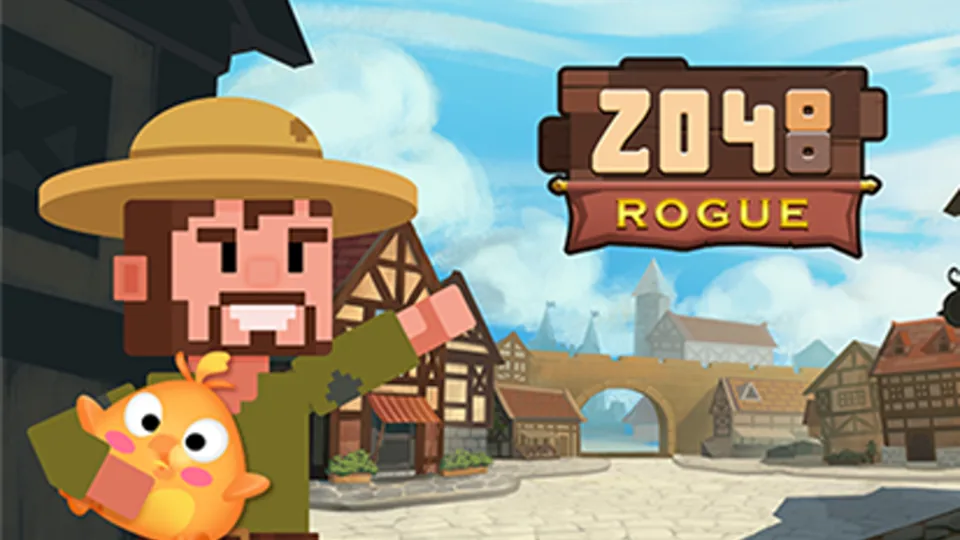
2048 Rogue turns the classic 4x4 merge board into a themed survival puzzle with evolving animals, objects, Endless scoring, and Story targets.
Creature-Tile 2048 Survival
2048 Rogue is a 4x4 merge puzzle that keeps the original 2048 movement rule and gives it a stronger theme. Every move slides the whole board in one direction, matching tiles collide into a higher tier, and a new low-tier tile appears after a valid move. If the board fills and no legal merge remains, the run ends.
The difference is identity. Instead of only watching numbered squares climb, 2048 Rogue uses creatures, animals, characters, and objects as merge tiers. That makes progression feel like an evolution chain. Two matching low-tier icons become the next form. Two of those become something stronger. Some versions of the chain present the early merges like small animals growing into stronger forms, while other theme sets lean into village, kingdom, or city objects. The puzzle is still spatial, but the visual reward is more personal than a plain number.
The title's "Rogue" should be read as run pressure, not a full dungeon RPG. There are no rooms to explore, weapons to loot, or enemies to fight directly. The board is the dungeon. Empty cells are health. Bad spawns are danger. A careless swipe can damage the run as surely as a bad step in a roguelike.
That framing matters because 2048 Rogue is not trying to replace classic 2048 with a complicated system. It keeps the single-board clarity and adds just enough personality to make each merge feel like progress through a set. The result is a compact strategy game where visual discovery, score survival, and level targets all come from the same four-direction rule.
Endless and Story Modes
2048 Rogue is built around two mode priorities. Endless mode is the score-survival format. Themes such as Medieval Village, Medieval Kingdom, and Modern City give the same merge rules different visual chains. Medieval Village tends to feel more pastoral and animal-led, Medieval Kingdom makes the progression feel like a stronger fantasy ladder, and Modern City gives the board a more object-driven identity. The goal is to survive as long as possible, push the score higher, and keep enough space open to handle new tile spawns.
Story mode is more directed. Instead of only lasting longer, the player works toward level targets, evolved creatures or objects, unlocks, and progression through tougher boards. That changes how moves should be judged. In Endless, the healthiest board state usually matters most. In Story, a target tile may be worth protecting even when another move would create a quick score bump.
The modes share the same controls: WASD or arrow keys slide the board up, down, left, or right, and touch-style play can use directional swipes where supported. The skill is not input complexity. The skill is board discipline. Every move changes the whole grid, so one swipe can either open space through chain merges or scatter the structure into isolated tiles.
This is where the "Rogue" flavor becomes useful. The run is not random because the player lacks control; it is tense because each valid move creates a new spawn that can land in an inconvenient cell. A strong board has a shape that can absorb that surprise. A weak board depends on the next tile appearing in exactly the right place. Endless mode rewards resilient shapes. Story mode rewards shapes that also protect the requested evolution path.
A leaderboard turns one-board survival into a measurable run. It does not change the merge rule, but it gives repeat attempts a reason beyond simply reaching the next icon once.
Corner Control and Board Health
The strongest basic plan is corner control. Pick one corner as the home for your highest-tier tile and try to keep it there. Then arrange nearby tiles in rough descending order so merges naturally feed toward the strongest piece. If the largest tile sits in the bottom-left corner, the tile to its right or above it should usually be the next smaller tier, followed by the next smaller tier after that. This reduces the chance that your best tile drifts into the middle and blocks movement.
The trap is using all four directions without a reason. Randomly alternating up, down, left, and right breaks merge structure. If your highest tile belongs in the bottom-left corner, for example, repeated left and down moves usually preserve the chain better than constantly sending the board upward and rightward. The opposite direction should be used carefully, usually only when no safer move exists.
Board health matters more than one flashy merge. A high-tier creature surrounded by mismatched low pieces is not strength; it is a blockage. A lower board with open cells, prepared pairs, and clean lanes is often healthier. Space gives you options. Options keep the run alive.
The healthiest boards have a quiet rhythm. Large tiles move rarely, medium tiles feed the anchor, and low tiles get cleaned before they spread across the middle. When that rhythm breaks, each spawn becomes another obstacle between tiles that should have merged earlier.
Chain Merges and Target Planning
Good 2048 Rogue play comes from planning chains. Before sliding, ask what will merge first, where the empty spaces will open, and whether the resulting board creates another merge. The best moves often trigger several small combinations at once, clearing clutter and rebuilding space.
Low-tier tiles deserve attention. They look harmless, but they clog the center quickly. Merge small pairs early so they do not isolate higher tiers later. If the middle becomes filled with unmatched low tiles, the board loses flexibility and every new spawn becomes dangerous. A common failure pattern is saving a future high merge while ignoring two or three small pairs that could have opened the board immediately.
Story mode adds another planning layer. If the level asks for a specific evolved creature or object, plan backward. Which merge chain creates that target? Which corner or side should hold the chain? Which low-tier tiles should be protected instead of merged elsewhere? Story mode rewards directed building, not just high-score survival.
Endless mode rewards patience. You can often delay risky merges if the board remains open. A run that survives steadily can outscore a run that makes one big tile early and then collapses because the support chain is gone.
The best board usually has three zones: the strongest tile anchored in a corner, nearby tiles forming the feeding chain, and the opposite side staying flexible enough to catch new spawns. When those zones collapse into one crowded middle, repair matters more than chasing the next impressive merge.
Why It Feels Different From Plain 2048
Classic 2048 is abstract. 2048 Rogue adds theme and mode structure without burying the clean rules. The player still understands the game in seconds, but the creature, animal, and object chains make each tier feel like a discovery. Medieval Village, Medieval Kingdom, and Modern City themes give repeat runs different flavor while preserving the same spatial challenge.
The roguelike feeling comes from uncertainty. A new tile appears after the move, and it may land somewhere that disrupts the plan. You cannot fully control the board. You can only build a structure resilient enough to absorb surprise. That makes the game feel alive even though the rules are simple.
The structure is compact strategy: short repeatable attempts, merge puzzles, and slow improvement through better planning. Action combat, loot builds, and dungeon exploration are not the point. Its best moments are quiet: a messy board clears through connected merges, a target creature appears where Story mode needs it, or an Endless run survives a bad spawn because the corner chain had enough slack.
Clean Run Habits
Start with Endless mode if you are learning. It gives more room to understand the merge chain, movement rules, and how quickly the board fills when swipes are careless. Choose a corner early and keep the strongest tile close to it.
Slow down when the grid gets crowded. Panic swipes usually create isolated tiles. Look for the smallest pairs first, especially in the middle. Clearing low clutter can restore enough empty cells to rebuild the main chain.
In Story mode, do not treat every move as a score chase. Target progress matters. If the goal requires a specific evolved icon, preserve the chain that leads to it. Sometimes the best move is not the one that creates the largest immediate merge, but the one that protects the path to the requested tier.
If a theme set feels confusing, switch modes or environments for a few runs and focus on tile order rather than icon art. Identical pieces merge, all pieces slide together, and empty space is the resource that lets the next decision exist. Once that is internalized, the animal, kingdom, or city skin becomes useful flavor rather than extra cognitive load.
The useful rule is simple: open space is power. A board with air can recover from bad spawns. Manage the whole grid, not one big tile.